The prescription price on your insurance card may not be the lowest - here’s how to find a better deal
The FTC’s proposed Caremark settlement could produce as much as $13 billion in prescription-drug savings over 10 years.

The government’s latest crackdown on pharmacy benefit managers could eventually lower prescription costs for millions of patients — but it does not eliminate the need to shop around.
The Federal Trade Commission announced a proposed settlement with CVS Caremark and its affiliated purchasing organization, Zinc Health Services, that would change how one of the nation’s largest drug middlemen handles rebates, formularies and payments to pharmacies.
The FTC estimates that the agreement could preserve up to $8.5 billion in consumer savings over 10 years and generate up to another $4.5 billion through rebates passed directly to patients at the pharmacy counter.
But those are projected systemwide savings, not checks that will be mailed to individual consumers. The amount any patient saves will depend on whether an employer or insurance plan adopts the new pricing options, which drugs the patient takes and how the plan calculates deductibles, copayments and coinsurance.
The settlement is also still a proposed consent order. It was accepted for a 30-day public-comment period and will carry the force of law only after the FTC issues a final order.
 James R. Hood
Why an expensive drug may be preferred
Caremark is a pharmacy benefit manager, or PBM. PBMs negotiate with drug manufacturers, design lists of covered drugs known as formularies, create pharmacy networks and process prescription claims for insurers and employer health plans.
In theory, PBMs use their bargaining power to obtain lower prices.
The FTC alleged that Caremark, Express Scripts and OptumRx instead developed a system that rewarded large rebates tied to high list prices. Drugmakers allegedly competed for favorable formulary placement by offering bigger rebates rather than lower net prices.
That system could result in a high-list-price medication receiving better insurance coverage than an equivalent drug with a much lower list price.
The PBM or its affiliated purchasing organization might collect a larger rebate or fee, while patients whose deductibles or coinsurance were based on the inflated list price paid more at the pharmacy counter, according to the FTC.
The FTC’s case focused primarily on insulin, but the incentive structure can affect other expensive brand-name and specialty drugs.
What the Caremark settlement would change
Under the proposed order, Caremark would have to stop discriminating against lower-list-price versions of drugs on its standard formularies.
It must also offer health plans an option under which rebates are passed through to patients at the point of sale. A patient’s cost could then be calculated using the plan’s negotiated price after rebates rather than the drug’s much higher list price.
Caremark would also have to offer plans a way to move away from rebate guarantees and “spread pricing,” in which a PBM charges a health plan more for a drug than it reimburses the pharmacy and retains the difference.
Other provisions would:
- Separate certain PBM and purchasing-organization fees from drug list prices.
- Increase pricing and rebate information available to health plans.
- Expand insulin affordability programs.
- Give community pharmacies an opportunity to use more transparent reimbursement arrangements.
- Prevent Caremark from unfairly blocking pharmacies from working with prescription “hub” services that help patients locate assistance and lower-cost options.
Similar to Express Scripts
The settlement follows a similar February 2026 agreement with Express Scripts. The FTC said that agreement could reduce patients’ out-of-pocket costs by as much as $7 billion over 10 years. It also required Express Scripts to stop favoring higher-list-price versions of drugs in its standard formularies and offer plans pricing based on net cost rather than an inflated list price.
The FTC has also withdrawn its case against OptumRx from active adjudication while it considers a proposed consent agreement.
What this means at the pharmacy counter
The settlements could gradually make lower-priced drugs easier to obtain and allow more rebates to reach patients directly.
They will not necessarily produce an immediate reduction every time someone fills a prescription.
Caremark and Express Scripts are required to offer many of the new arrangements to employers and health plans. In some cases, the employer or insurer must elect to use them.
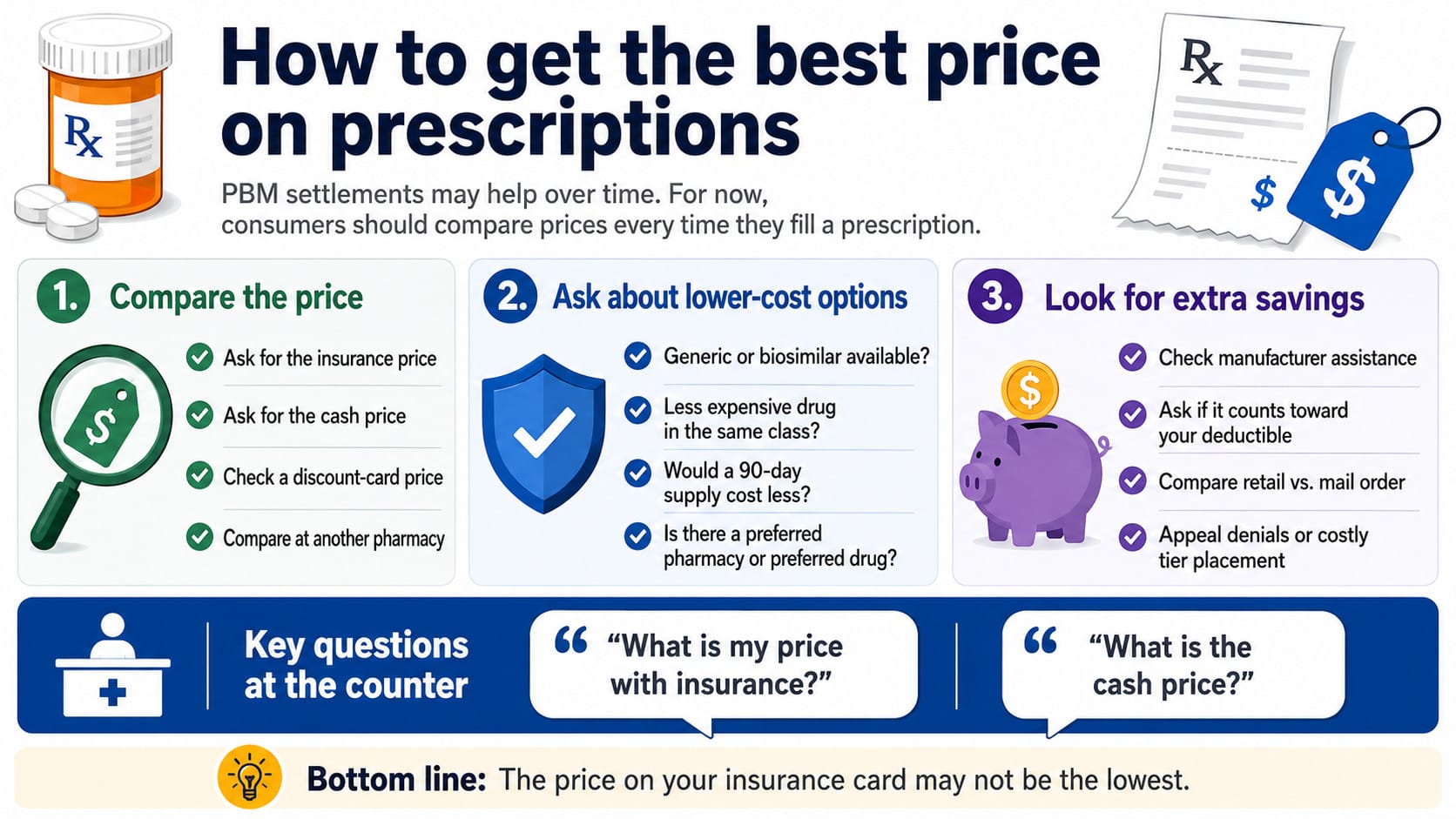
Consumers therefore should not assume that the price generated when a pharmacist runs an insurance claim is automatically the best available price.
A prescription can have several different prices:
- The price using insurance.
- The pharmacy’s regular cash price.
- A price offered through a prescription-discount service.
- A manufacturer’s direct-purchase or assistance-program price.
- A lower price for a generic, biosimilar or alternative medication.
- A different price at another pharmacy in the same insurance network.
The lowest option can vary not only by drug but also by dosage, quantity, pharmacy and month.