Tank, Tankless, Heat Pump or Solar? What Homeowners Need to Know Before Replacing a Water Heater
Hot water might not be on your mind right now, but it will be if your present heater conks out.
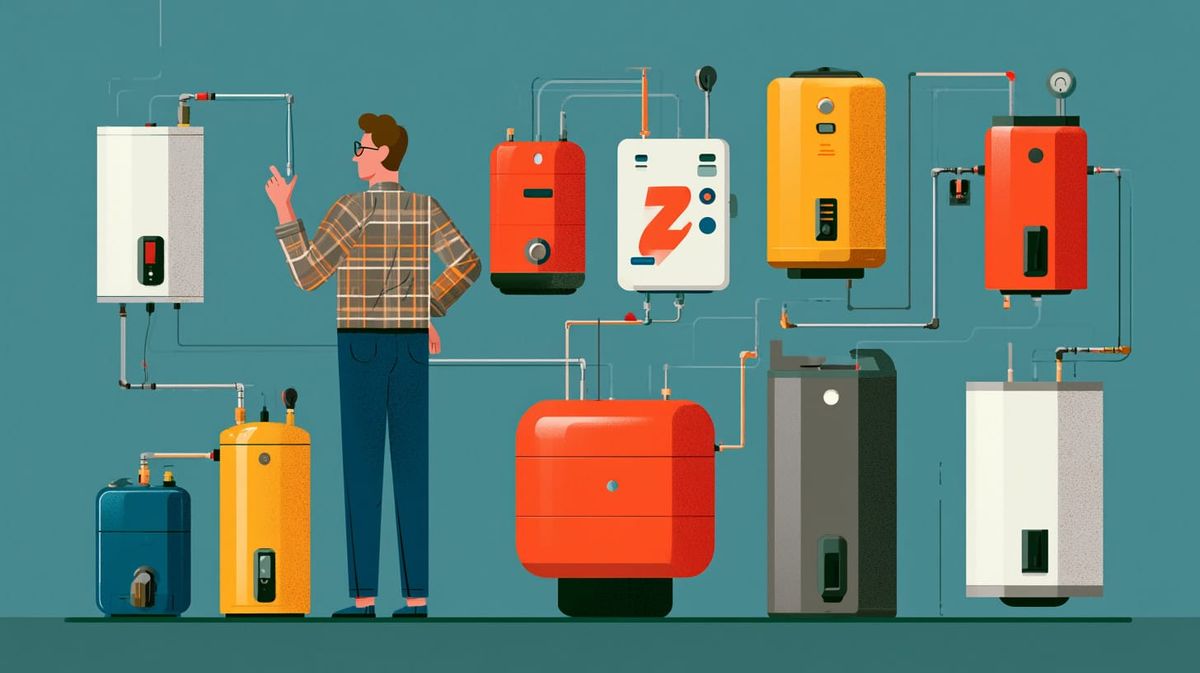
Hot water seems pretty simple but it can get complicated when it's time to replace or upgrade your water heater, that mysterious tanklike thing that sits in a dark corner of the basement or utility room.
It might not be the most fascinating topic but it's an important one. Water heating is the second-biggest energy expense in most American homes, typically accounting for roughly 18% of a household's total energy use, according to Consumer Reports — and that share climbs higher in homes with an older electric tank. With utility rates rising and manufacturers required to phase in stricter federal efficiency standards, homeowners shopping for a new unit now face a real menu of choices, not just "gas or electric."
We've put together a look at the five major kinds of residential water heaters — conventional gas tank, conventional electric tank, gas tankless, electric tankless, heat pump (hybrid electric), and solar — including the pros and cons of each.
A few highlights worth noting:
- Heat pump water heaters now win the 10-year total-cost math, running around $184/year to operate versus roughly $267 for condensing gas tankless and $351 for a standard gas tank, even though the equipment costs 2-3x more upfront than a standard electric tank.
- Timely note for 2026: the federal 25C tax credit (up to $2,000/year for heat pump water heaters) expired for anything placed in service after December 31, 2025, after the One Big Beautiful Bill Act ended it early — confirmed on the IRS site. Anyone installing in 2026 is now dependent entirely on state/utility rebates, which is a genuinely new wrinkle worth calling out to readers who may still expect that credit.
- Tankless (gas or electric) payback is more marginal than marketing suggests — DOE-based estimates put savings at just ~$110/year (gas) or ~$45/year (electric) versus a standard tank, pushing simple payback to 7-10+ years, sometimes longer than the homeowner stays in the house.
- Solar has the highest ceiling (50-80% energy cut) and the highest sticker price ($3,000-$9,000 before incentives), making it most attractive for sunny-climate homeowners planning to stay long-term.
The efficiency scorecard: UEF, explained
Every water heater sold today carries a Uniform Energy Factor (UEF) rating — the metric that replaced the older Energy Factor scale in 2017. The higher the number, the less energy is wasted heating water. Standard gas and electric tank models generally fall in the 0.58–0.70 range; tankless units reach 0.80–0.98; and heat pump water heaters are the outlier, posting UEF ratings of 3.3 to 4.1 because they move heat rather than generate it — the equivalent of 330% to 410% efficiency, per ENERGY STAR. Keep that scale in mind as you read the breakdown below.
Side-by-side comparison
| Type | Typical UEF | Installed Cost | Est. Annual Operating Cost* | Lifespan |
|---|---|---|---|---|
| Gas storage tank | 0.58–0.70 | $1,200–$2,500 | ~$351 | 8–12 yrs |
| Electric storage tank | 0.58–0.70 | ~$1,000–$1,800 | Highest of storage options | 8–12 yrs |
| Gas tankless (incl. condensing) | 0.80–0.98 | $1,100–$7,000 | ~$267 | 20+ yrs |
| Electric tankless | ~0.93+ | Unit $500–$800 (install varies) | Moderate; savings ~$45/yr vs. tank | 20+ yrs |
| Heat pump (hybrid electric) | 3.3–4.1 | $2,200–$3,500 | ~$184 (lowest) | ~12–15 yrs |
| Solar (with backup) | Varies by climate | $3,000–$9,000 | Backup fuel only, cut 50–80% | 20–30+ yrs (collectors) |
*Operating-cost figures drawn from BuildingTalks' 2026 cost modeling at $0.16/kWh electric and $1.30/therm gas; actual costs vary by local utility rates and household usage.
The grisly details
Here's how the five main options stack up on efficiency, upfront cost, operating cost, and the trade-offs that don't show up on the price tag.
1. Conventional Gas Storage Tank
The default choice in most American homes for decades — a 30- to 80-gallon tank kept hot around the clock by a gas burner.
Advantages
- Lowest upfront purchase and installation cost of any option — typically $1,200–$2,500 installed for a standard tank, according to HVACBase.
- Recovers quickly and can supply large volumes of hot water back-to-back, which suits big families.
- Natural gas is generally the cheapest fuel per unit of heat, so operating costs run lower than an electric tank of the same size, per Consumer Reports.
Disadvantages
- Standing pilot lights and constant reheating of stored water waste energy 24/7 — UEF typically 0.58–0.70, the least efficient category on the market (HVACBase).
- Shortest typical lifespan of the mainstream options: 8–12 years.
- Requires gas service and proper venting, which isn't an option (or is costly to add) in all-electric homes.
- Standard units still lose real money over the long run compared with heat pump or condensing models — Consumer Reports rates them "much less efficient" than heat-pump units and "slightly less efficient" than gas tankless models.
2. Conventional Electric Storage Tank
The all-electric equivalent — a heating element inside an insulated tank, no gas line required.
Advantages
- Simple installation anywhere with a 240-volt circuit; no venting or gas line needed, which makes it the go-to for homes without gas service.
- Lower equipment cost than heat pump or tankless electric models.
- No combustion byproducts to vent, and no risk of gas leaks.
Disadvantages
- Most expensive to operate of the mainstream storage options — Consumer Reports gives standard electric tanks "low-level scores for energy consumption costs," meaning higher monthly bills than gas or heat pump alternatives.
- Standing heat loss from the tank means you're paying to reheat water you aren't using.
- Recovery time (how fast it reheats after a big draw) is generally slower than gas.
- Same 8–12 year lifespan ceiling as gas tanks, with corrosion and sediment buildup common failure points.
3. Tankless (On-Demand) Gas Water Heater
Heats water only as it flows through the unit, using a high-output gas burner — no storage tank, no standby heat loss.
Advantages
- The U.S. Department of Energy estimates tankless units run 24–34% more energy efficient than tank models in homes using 41 gallons or less of hot water a day, per RateYourPlumber.
- Endless hot water — no running out mid-shower during heavy use.
- Compact, wall-mounted footprint frees up floor space.
- Long service life: 20+ years, roughly double a tank unit's lifespan.
Disadvantages
- High installed cost: $1,100–$5,100 versus $400–$1,200 for a standard tank, largely because of gas line upsizing and new venting, per RateYourPlumber. Condensing tankless models with the highest efficiency can run $3,500–$7,000 installed, according to BuildingTalks.
- Real-world savings are modest — around $110/year for gas tankless versus a standard gas tank — which stretches the simple payback period to 7–10 years, and in some cost comparisons, over 30 years, longer than many homeowners stay in one house.
- Savings shrink further (to 8–14% efficiency gain) in high-usage households drawing 86+ gallons a day.
- Requires a dedicated gas line, often 3/4-inch or larger, which can mean opening walls in older homes.
4. Tankless (On-Demand) Electric Water Heater
The no-gas version of on-demand heating — an electric element heats water instantly as it passes through, with no tank.
Advantages
- More energy-efficient than electric storage tanks because there's no standby loss from keeping a tank hot 24/7, per Camplux.
- Easier to install than gas tankless in many cases — no venting or gas line, just electrical work.
- Compact and wall-mountable, useful for point-of-use applications (a single bathroom or kitchen sink) as well as whole-house setups.
Disadvantages
- Unit cost of $500–$800 is only part of the story — whole-home electric tankless units often need a substantial electrical service upgrade to handle the high amperage draw, an expense easy to underestimate.
- Struggles with simultaneous demand: running two showers and a dishwasher at once can outstrip a single unit's capacity, especially in homes with weaker electrical service.
- Annual savings versus a standard tank are smaller than gas tankless — roughly $45/year — stretching payback even further.
- Performance is more climate-sensitive than gas tankless, since electric heating elements have less raw output to overcome cold incoming groundwater.
5. Heat Pump (Hybrid Electric) Water Heater
The efficiency leader on paper: instead of generating heat directly, it extracts ambient warmth from the surrounding air (basement, garage, utility closet) and transfers it into the tank — similar to how a refrigerator works in reverse.
Advantages
- Dramatically more efficient than any other electric option — 2 to 3.5 times the efficiency of a standard electric tank, cutting the water-heating bill by roughly $300–$500 a year for a typical family of four, per GreenSaveHome. In high-electricity-cost states, annual savings can top $700.
- Over a 10-year horizon, total cost of ownership (equipment plus operating cost) is typically the lowest of any water heater type — even beating gas — despite the higher sticker price, according to the same analysis.
- Lower carbon footprint since it runs on electricity at 300%+ efficiency rather than combusting fuel.
- Independent cost modeling from BuildingTalks puts annual operating cost at roughly $184/year, versus $267 for condensing gas tankless and $351 for a standard gas tank, at typical utility rates.
Disadvantages
- Highest upfront equipment cost among electric options: $2,200–$3,500 installed for a 50-gallon unit, roughly 2–3 times a standard electric tank, per GreenSaveHome.
- Important for 2026 buyers: the federal 25C tax credit that used to cover up to $2,000 for heat pump water heaters expired for equipment placed in service after December 31, 2025, after being ended early by the One Big Beautiful Bill Act signed in July 2025, per the IRS and ElectrifyAtlas. Homeowners installing a unit in 2026 will need to rely on state or utility rebates instead — the federal credit is gone. (A separate 30% geothermal heat pump credit, unrelated to water heaters, remains through 2032.)
- Needs a surrounding air space of roughly 700+ cubic feet — typically a basement, garage, or utility room — and works best in spaces that stay above about 40°F year-round; performance drops in very cold, tightly sealed closets.
- Produces cool, slightly dehumidified air as a byproduct, which is a bonus in a hot basement but a drawback in an already-cold one.
- Runs quieter than an air conditioner but is audibly louder than a standard tank, which matters if it's installed near living space.
6. Solar Water Heater
Uses rooftop or ground-mounted collectors to capture the sun's heat directly, either heating water in an integrated tank or transferring heat through a closed loop to a conventional backup tank.
Advantages
- The biggest efficiency ceiling of any option: DOE and NREL data show solar water heaters cut water-heating energy use by 50–80%, depending on climate, per Solar Powered Water Heaters.
- In sunny states like Arizona, California, and Texas, homeowners often see 70–80% reductions and save $300–$450 a year; even in colder Northeast or Midwest climates, savings of 50–60% and $150–$250 a year are typical.
- Long-lived hardware — quality collectors last 20–30+ years with minimal upkeep, making the cost-per-unit-of-energy-saved among the best of any home energy investment.
- Simple passive designs (thermosiphon/batch systems) have very low maintenance needs and no moving parts to fail.
Disadvantages
- Highest upfront investment of any option covered here: $3,000–$9,000 before incentives, versus roughly $500–$1,500 for a conventional heater, per Solar Powered Water Heaters.
- Typical payback period runs 5–15 years, so the economics work best for homeowners planning to stay put.
- Always needs a backup heat source (gas or electric) for cloudy stretches and winter, so it's an add-on rather than a full replacement in most climates.
- Direct-circulation systems risk freeze damage in cold climates and scale buildup in hard-water areas; indirect (glycol) systems avoid that but add heat-exchanger losses, higher upfront cost, and require glycol testing/replacement every 3–5 years.
- Requires adequate, unshaded roof or yard space with good solar exposure — not every lot or roof orientation qualifies.
The Bottom Line for Homeowners
- Cheapest to buy, most expensive to run: conventional electric tanks.
- Best balance for gas-equipped homes on a budget: a standard gas tank, if minimizing upfront cost matters more than long-term savings.
- Best long-term value if you're staying in the house 10+ years and have space for the equipment: a heat pump water heater — it now wins the 10-year total-cost comparison even without the expired federal tax credit, provided a state or utility rebate is available.
- Best for large households worried about running out of hot water, with an existing large gas line: gas tankless, understanding the payback period may exceed your time in the home.
- Best for sunny climates and homeowners planning to stay long-term: solar, paired with a backup heater, especially where local rebates offset the high upfront cost.
Before buying, homeowners should check with their state energy office and local utility — with the federal 25C credit gone for 2026 installations, state and utility rebate programs are now the primary financial lever for anyone considering a heat pump, solar, or high-efficiency tankless system.
Sources
- Consumer Reports, Water Heater Buying Guide
- ENERGY STAR, Uniform Energy Factor (UEF) ratings
- HVACBase, Water Heaters: Complete Guide to Tank vs Tankless
- RateYourPlumber, Tankless Water Heater Pros and Cons
- Camplux, What is the downside of an electric tankless water heater?
- GreenSaveHome, Heat Pump Water Heater: Is It Worth the Upgrade? (2026 Guide)
- BuildingTalks, Tankless vs Tank Water Heater 2026
- Solar Powered Water Heaters, Solar Water Heaters 101
- IRS, Energy Efficient Home Improvement Credit
- ElectrifyAtlas, Federal Heat Pump Tax Credits Status 2026
Perplexity.ai provided research assistance for this article.