How to get the best prescription price
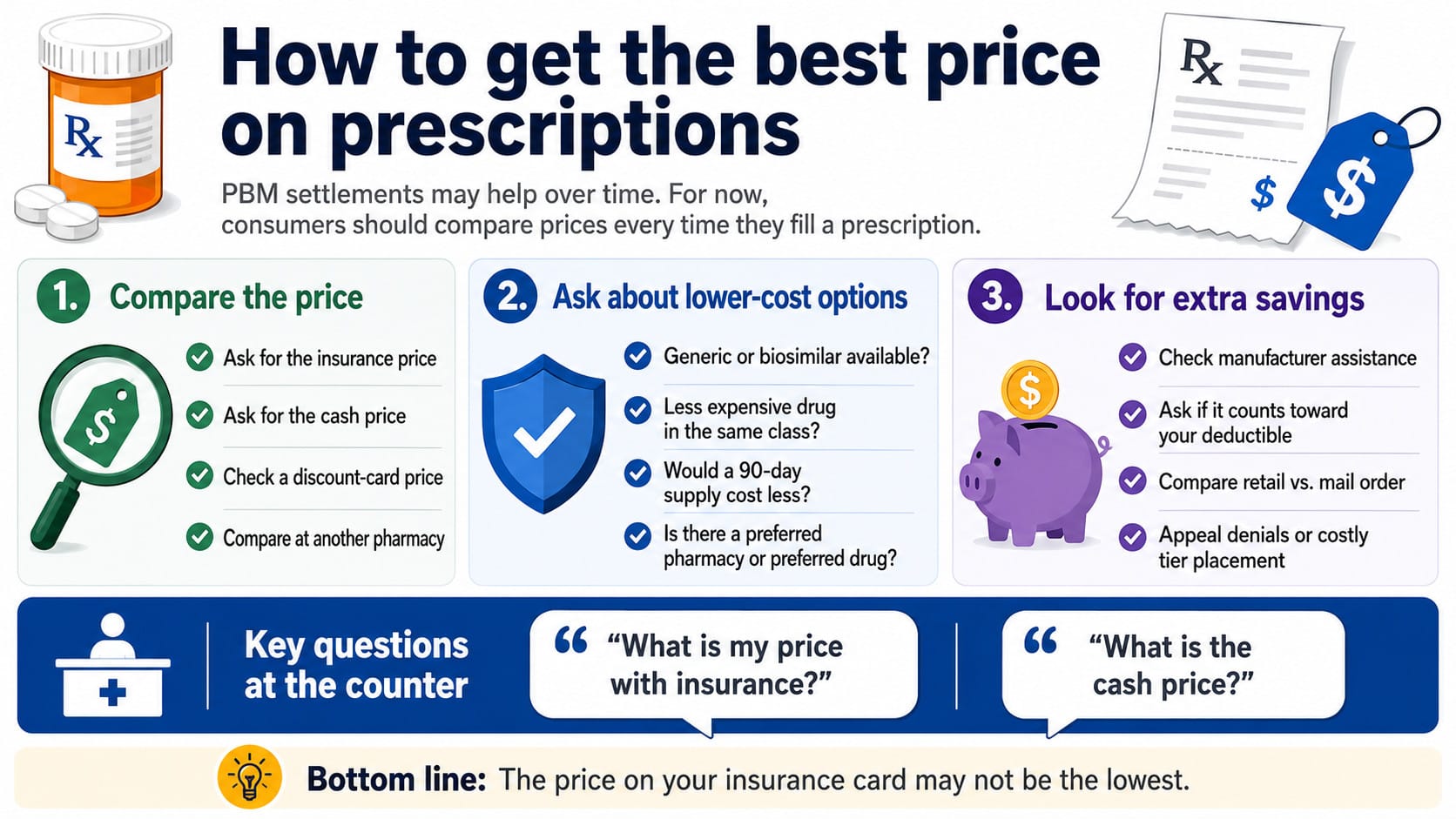
Ask the pharmacist for the insurance price and the cash price.

Before paying, ask the pharmacist two questions:
- “What is my price using insurance?”
- “What would the same prescription cost if I paid cash?”
For some inexpensive generic drugs, a pharmacy’s cash price or membership-program price may be lower than the insurance copayment.
Paying cash may have a disadvantage, however. The purchase may not automatically count toward an insurance deductible or annual out-of-pocket limit. Consumers should ask their plan whether they can submit the receipt and whether the expense will be credited.
 James R. Hood
Compare several pharmacies
Prescription prices can differ sharply among pharmacies, even within the same city.
Check the price at:
- A preferred pharmacy listed by the insurance plan.
- An independent community pharmacy.
- A supermarket or warehouse pharmacy.
- A mail-order pharmacy.
- A legitimate online pharmacy.
- At least one prescription-price comparison service.
A pharmacy that is “in network” may still cost more than one designated as “preferred.” Medicare advises Part D members that some plans provide discounts or cover certain drugs only through network pharmacies. It also recommends asking whether a two- or three-month supply may be more economical for medications taken regularly. (Medicare)
Ask the prescriber about generics
Consumers should ask whether the prescription can be filled with a generic drug and whether the prescription permits generic substitution.
FDA-approved generics must match the brand-name drug in dosage form, strength, safety, quality, route of administration and intended use, according to the U.S. Food and Drug Administration.
Generics usually cost less, but the least expensive generic can vary by pharmacy and insurer.
Ask about a lower-cost drug in the same class
Sometimes the cheapest option is not a generic version of the prescribed drug but a different medication that treats the same condition.
Ask the prescriber:
“Is there a less expensive drug in the same class that would work for me?”
“Is there a preferred drug on my insurance formulary?”
“Is there a lower-list-price version that avoids the deductible or high coinsurance?”
Consumers should never switch drugs, alter a dose or split pills without approval from the prescriber or pharmacist.
Ask whether a biosimilar is available
Biologic drugs used to treat conditions such as arthritis, cancer, diabetes and inflammatory diseases can be extremely expensive.
An FDA-approved biosimilar is highly similar to an existing biologic and has no clinically meaningful differences in safety or effectiveness. Biosimilars may cost less and may be covered more favorably by an insurance plan.
Availability and substitution rules vary, so patients should discuss the option with both the prescriber and pharmacist.
Check manufacturer assistance
Manufacturers of expensive brand-name and specialty medications may offer:
- Copay assistance for people with commercial insurance.
- Free or discounted drugs for qualifying uninsured patients.
- Income-based patient-assistance programs.
- Temporary supplies while an insurance appeal is pending.
Manufacturer copay coupons generally cannot be used by people enrolled in federal health programs such as Medicare or Medicaid, but separate patient-assistance programs may be available.
Prescription hub services may also help patients complete prior-authorization paperwork, compare out-of-pocket options and connect with financial assistance. The Caremark settlement specifically prohibits certain interference with pharmacies that use these services.
Compare discount prices carefully
Prescription-discount cards and websites can offer substantial savings, particularly for generic drugs and people with high deductibles.
But a discount card is not insurance. It normally replaces the insurance transaction rather than supplementing it.
Before using one, compare:
- The insurance price.
- The discount-card price.
- The pharmacy’s cash price.
- The price at a competing pharmacy.
Also check whether the advertised price applies to the exact dosage, quantity and formulation prescribed.
Request a 90-day supply
For medications taken continuously, a 90-day supply may carry a lower cost per dose than three separate 30-day prescriptions.
Compare both the retail and mail-order price. Mail order is not automatically cheaper, and it may be less suitable for drugs whose dosage changes frequently or that require special handling.
Appeal formulary and coverage decisions
When an insurer refuses to cover a prescribed drug or places it on a costly tier, the patient and prescriber may be able to request:
- Prior authorization.
- A formulary exception.
- A tiering exception.
- A medical-necessity review.
- An expedited appeal.
The prescriber should explain why covered alternatives are ineffective, unsafe or medically inappropriate.
Review coverage every year
Drug formularies, pharmacy networks and cost-sharing rules can change annually.
Medicare beneficiaries should compare Part D and Medicare Advantage drug coverage during open enrollment using their complete medication list and preferred pharmacies. A plan with a low premium may be much more expensive after deductibles and drug copayments are included.
Medicare beneficiaries with limited income and resources should also check eligibility for Extra Help, which can reduce Part D premiums, deductibles and other prescription expenses, according to Medicare.
Prescription price checklist
Before filling a costly prescription:
- Ask for the price with insurance.
- Ask for the pharmacy’s cash price.
- Check at least two competing pharmacies.
- Compare a reputable discount price.
- Ask whether the purchase will count toward your deductible.
- Ask about a generic, biosimilar or lower-cost alternative.
- Check the insurance formulary for preferred drugs.
- Look for manufacturer assistance.
- Ask whether a 90-day supply costs less.
- Request an appeal if the plan rejects the medically appropriate drug.
The bottom line
The Caremark and Express Scripts settlements attack a prescription-pricing system in which larger rebates could make an expensive drug more attractive to a PBM than a cheaper alternative.
If the promised changes are widely adopted by employers and insurers, consumers could see lower prices, more rebate savings at the pharmacy counter and greater access to lower-list-price drugs.
But the drug-pricing system remains fragmented and difficult to navigate. Until the price presented to every patient reliably reflects the lowest available cost, consumers should treat each expensive prescription as a purchase that needs to be compared — not as a fixed price determined by the insurance card.