Trump’s CFPB nominee says he won’t eliminate the agency — but its future remains uncertain
Brian Johnson told senators that abolishing the Consumer Financial Protection Bureau is “not my intention”
President Trump’s nominee to lead the Consumer Financial Protection Bureau says he does not intend to eliminate the agency, putting some distance between himself and administration officials who have openly called for its closure.
Appearing before the Senate Banking Committee, Brian Johnson was asked whether he supported doing away with the CFPB.
“That is not my intention,” Johnson replied. “The CFPB is a creature of statute.”
“My intention is to execute the law,” he added, according to Consumer Finance Monitor.
The answer may reassure consumers worried that the federal government’s principal financial watchdog could disappear altogether. But Johnson offered fewer assurances about whether the bureau would retain enough employees, resources and enforcement authority to perform the duties Congress assigned to it.
Johnson said he would keep an “open mind” about the administration’s pending plan to dismiss most of the CFPB’s remaining workforce and would review staffing needs before making a decision.
That leaves the central question unresolved: Even if the CFPB continues to exist legally, will it remain capable of protecting consumers?
 The Editors
A softer tone, but few firm commitments
Johnson’s statements represented a notable change in tone from Acting CFPB Director Russell Vought, who has sharply criticized the agency and oversaw efforts to halt much of its work and dramatically reduce its staff.
Federal courts blocked parts of the administration’s attempt to dismantle the bureau, while litigation over the proposed workforce reductions has continued. During Vought’s tenure, the CFPB suspended or abandoned numerous enforcement cases and sharply curtailed regulatory and supervisory activity.
Johnson did not endorse those efforts outright. But he also did not promise to reverse them.
He said he would assess the bureau’s staffing and organization after taking office, leaving open the possibility that the CFPB could remain a much smaller and less aggressive agency.
For consumers, that distinction matters. Congress can preserve an agency on paper while an administration limits its effectiveness by reducing staff, abandoning investigations, narrowing enforcement standards or declining to write new rules.
Who is Brian Johnson?
Johnson is currently a vice president and U.S. card compliance officer at Capital One. He previously served as the CFPB’s deputy director during President Trump’s first term, working under former Director Kathy Kraninger.
In that role, Johnson helped oversee the bureau’s rulemaking, supervision and enforcement operations. He later worked for Patomak Global Partners, a Washington consulting firm serving financial-industry clients.
Johnson has been a longtime critic of the CFPB’s structure and has previously supported proposals that would subject the agency to congressional appropriations and reduce its independence. At the same time, former colleagues have described him as an experienced consumer-finance lawyer who favors restructuring the CFPB rather than eliminating it entirely.
His current employment at Capital One has created potential conflicts of interest because the CFPB regulates the bank and recently dropped an enforcement case involving it.
Johnson has agreed to recuse himself from Capital One matters for two years if he is confirmed. He would also forfeit unvested Capital One shares, Banking Dive reported.
Why the CFPB matters to consumers
Congress created the CFPB through the 2010 Dodd-Frank financial reform law after the mortgage and lending abuses that contributed to the 2008 financial crisis.
The bureau supervises large banks, mortgage companies, credit bureaus, debt collectors, payday lenders, student-loan servicers and other financial businesses. It also accepts consumer complaints, writes financial-protection rules and brings enforcement cases against companies accused of violating federal law.
Since beginning operations in 2011, CFPB enforcement and supervisory work has produced more than $21 billion in monetary compensation, canceled debts, principal reductions and other forms of consumer relief, according to the bureau.
More than 205 million consumers or consumer accounts have been eligible for relief resulting from that work.
Among its largest distributions was a $1.8 billion payment program for 4.3 million consumers charged allegedly illegal fees by credit-repair companies including Lexington Law and CreditRepair.com.
The CFPB also operates a Civil Penalty Fund that uses penalties collected from lawbreaking companies to compensate consumers who otherwise might never recover their losses.
The agency has survived legal challenges
Opponents have repeatedly challenged the CFPB’s structure and funding in court.
In 2020, the Supreme Court ruled that presidents must be able to remove the CFPB director at will, eliminating a provision that had protected the director from dismissal without cause. The court nevertheless allowed the bureau itself to continue operating.
In May 2024, the Supreme Court rejected another sweeping challenge, ruling 7-2 that the CFPB’s funding mechanism complies with the Constitution’s Appropriations Clause.
Those decisions mean a president cannot simply declare the bureau nonexistent. Congress created the CFPB by statute, and Congress would generally have to pass new legislation to abolish it.
An administration can, however, sharply reduce the agency’s operations through personnel decisions, enforcement priorities, funding requests and regulatory policy.
That is why Johnson’s refusal to endorse abolition does not settle the CFPB’s future.
The enforcement question
The most consequential issue may not be whether the letters “CFPB” remain on an office door. It may be whether the agency continues investigating banks and financial companies accused of harming consumers.
Under acting leadership, the bureau dropped or withdrew several major enforcement actions, including cases involving Capital One and the bank-owned Zelle payment network.
The administration also moved to reverse or abandon rules addressing overdraft charges, credit-card late fees and other expenses paid by consumers.
Supporters of the changes say the previous CFPB imposed excessive costs, discouraged financial innovation and pursued enforcement cases without sufficiently clear legal standards.
The bureau’s current website cites a Council of Economic Advisers estimate claiming that CFPB regulation has cost consumers between $237 billion and $369 billion since 2011.
Consumer advocates strongly dispute that portrayal. They argue that the agency has returned billions of dollars to victims, deterred illegal conduct and given consumers a central place to report problems involving mortgages, credit cards, credit reports, debt collection and digital payments.
 The Editors
What consumers should watch
Johnson’s confirmation hearing produced a statement in favor of following the law, but few concrete promises about how aggressively he would enforce it.
The most important indicators will be measurable:
- Whether the CFPB restores investigators, examiners and complaint-processing staff.
- Whether it resumes enforcement cases against major financial institutions.
- Whether companies that violate consumer laws are required to repay harmed customers.
- Whether complaints continue to be forwarded to companies and resolved promptly.
- Whether the bureau publishes reliable information about emerging financial products, fees and scams.
- And whether Johnson operates independently when cases involve Capital One or other former employers and clients.
The Senate Banking Committee must vote on Johnson’s nomination before it can advance to the full Senate. Republicans control the committee, making confirmation likely unless opposition develops within the majority.
What consumers can do now
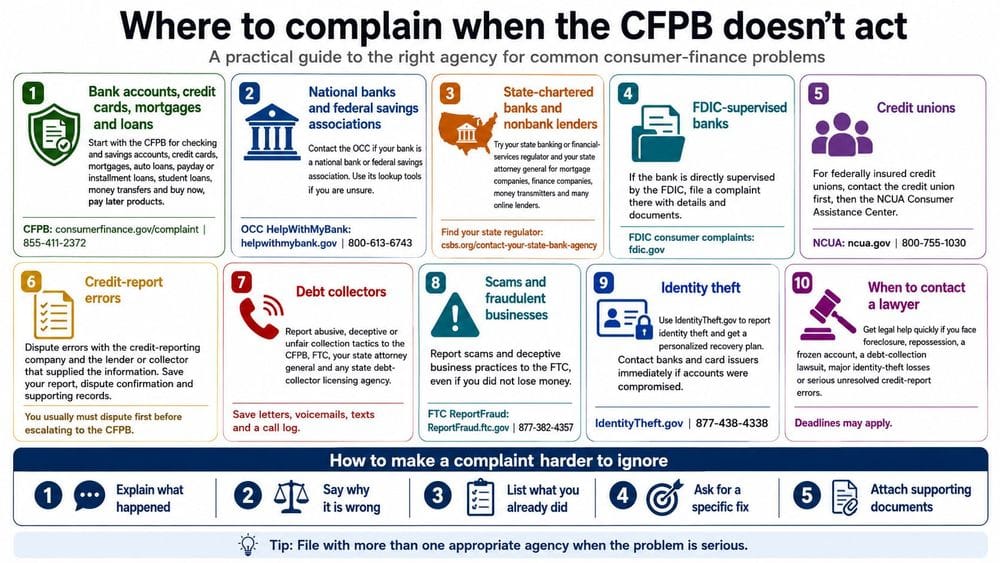
Consumers should continue submitting complaints through the CFPB when they encounter unresolved problems involving credit cards, mortgages, bank accounts, credit reports, debt collection, student loans or money-transfer services.
A complaint creates a documented record and may be forwarded to the financial company for a response. Even if enforcement activity remains limited, complaint data can help state regulators, attorneys general, journalists and private lawyers identify patterns of abuse.
Consumers can also complain to:
- Their state attorney general
- Their state banking or financial-services regulator
- The Federal Trade Commission
- The Office of the Comptroller of the Currency, for many national banks
- The National Credit Union Administration, for federally insured credit unions
Johnson’s assurance that he does not intend to eliminate the CFPB is significant. But consumers will ultimately judge his tenure not by whether the agency technically survives, but by whether it once again produces investigations, enforcement orders and refunds for people harmed by financial companies.