Where to complain when the CFPB doesn’t act
Who do you complain to when the complaint agencies are muzzled and defanged?
Whittled away by the Trump Administration, the Consumer Financial Protection Bureau is a shadow of its former self. A growing band of organizations and lawyers are trying to fill some of the gaps but it's not as easy as it once was for consumers to get help.
Filing a complaint with the Consumer Financial Protection Bureau is still a sensible first step. The CFPB says it forwards complaints to companies for response and routes cases to another government agency when appropriate. Most companies respond within 15 days.
But consumers should not necessarily stop there.
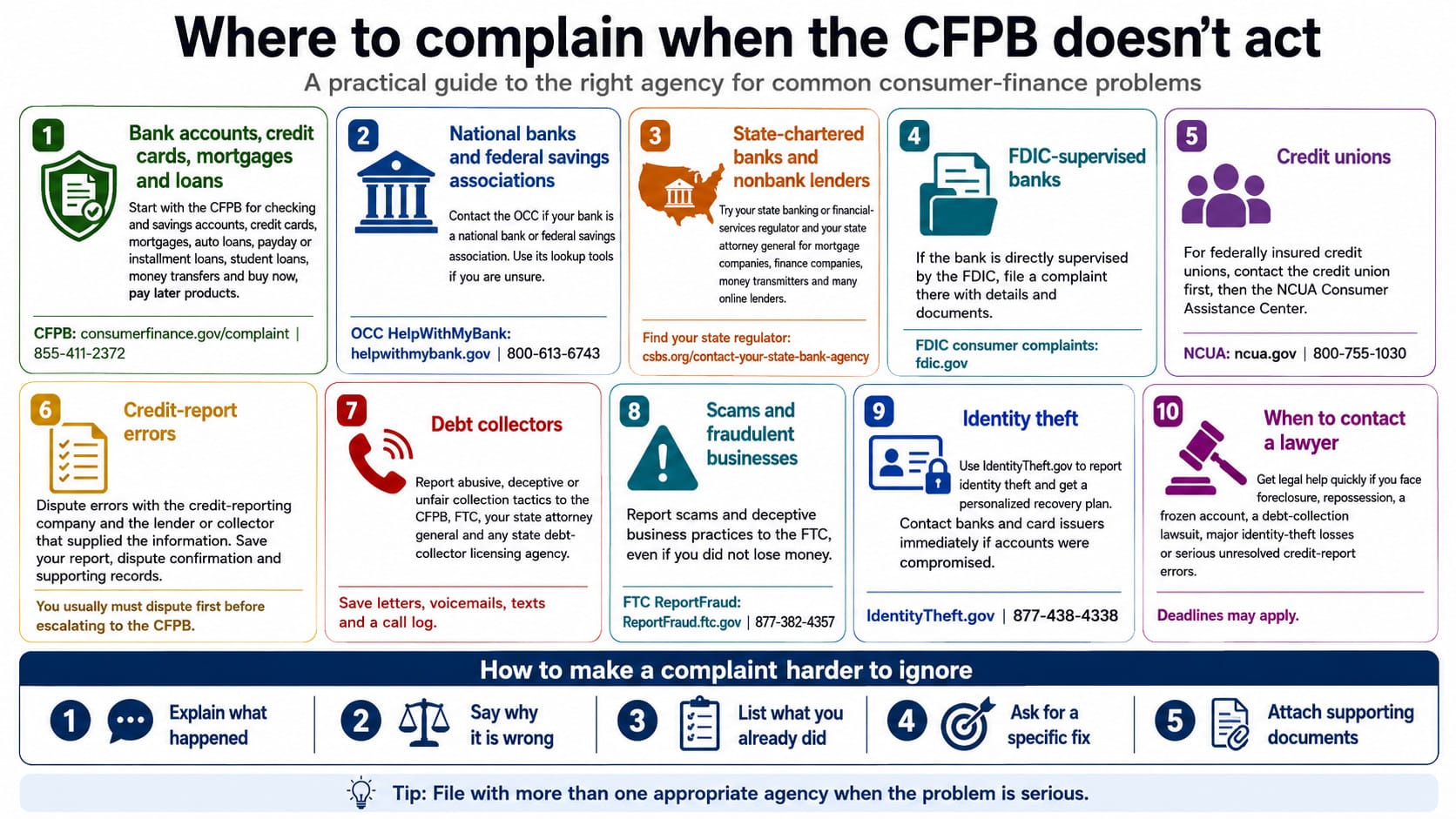
Bank accounts, credit cards, mortgages and consumer loans
Start with the CFPB for problems involving:
- Checking and savings accounts;
- Credit cards;
- Mortgages and home-equity loans;
- Auto loans;
- Payday and installment loans;
- Student loans;
- Money-transfer services; and
- Buy now, pay later products.
Consumers can submit a complaint online or call 855-411-2372.
Also complain directly to the company in writing. Ask for a complaint or case number and keep copies of every response.
National banks and federal savings associations
The Office of the Comptroller of the Currency, or OCC, handles complaints involving national banks and federal savings associations.
The OCC’s HelpWithMyBank service allows consumers to confirm whether the agency regulates their bank and submit a complaint. Its customer-assistance number is 800-613-6743.
A bank’s name may include “National,” “N.A.” or “Federal Savings,” but consumers should use the OCC’s bank lookup rather than relying on the name alone.
State-chartered banks and nonbank lenders
Complaints involving state-chartered banks, mortgage companies, finance companies, money transmitters and many online lenders may belong with a state banking or financial-services regulator.
The Conference of State Bank Supervisors maintains a directory of state banking agencies, at CSBS.
Consumers can also contact their state attorney general or state consumer-protection office. State officials may investigate patterns of misconduct, enforce state law or join multistate enforcement actions. Here's a complete list: USAGov.
FDIC-supervised banks
The Federal Deposit Insurance Corp. accepts complaints involving banks it directly supervises.
The FDIC asks consumers to provide identifying information, the bank’s name, a description of the problem and relevant supporting documents.
Because several different agencies supervise banks, consumers who are uncertain can begin with the CFPB or use federal bank-regulator lookup tools.
Credit unions
For a dispute involving a federally insured credit union, contact the credit union first and then file with the National Credit Union Administration’s Consumer Assistance Center: NCUA.
The center helps consumers resolve disputes involving credit-union accounts and loans. Its consumer-assistance number is 800-755-1030.
State-chartered credit unions may also be overseen by a state credit-union regulator.
Credit-report errors
Dispute inaccurate information directly with the credit-reporting company and with the bank, lender or debt collector that supplied the information.
Keep copies of:
- The credit report showing the error;
- The dispute letter or online confirmation;
- Supporting statements and payment records; and
- The company’s investigation results.
The CFPB currently requires consumers complaining about inaccurate or incomplete credit-report information to have first filed a dispute with the credit-reporting company. The consumer must generally wait until the dispute is no longer pending or 45 days have passed.
Debt collectors
Report abusive, deceptive or unfair collection practices to:
- The CFPB;
- The Federal Trade Commission;
- The state attorney general; and
- The state agency that licenses debt collectors, where applicable.
Save voicemail messages, letters, emails, text messages and a log of calls. Do not surrender original documents.
Scams and fraudulent businesses
Report scams, impostors and deceptive business practices to the Federal Trade Commission at ReportFraud.ftc.gov.
The FTC accepts reports even when the consumer did not lose money. Reports help investigators identify patterns, although filing one does not guarantee that the FTC will recover an individual consumer’s money.
Consumers who cannot file online can call 877-382-4357.
Identity theft
Use IdentityTheft.gov to report identity theft and create a personalized recovery plan.
The service provides step-by-step instructions for contacting businesses, closing fraudulent accounts and correcting credit reports. Consumers can also report identity theft by calling 877-438-4338.
Contact banks and card issuers immediately if money has been taken or accounts have been opened fraudulently. Speed can determine whether transactions can be stopped or reversed.
When to contact a lawyer
Consider consulting a consumer attorney or legal-aid organization when:
- A home is facing foreclosure;
- A car is about to be repossessed;
- A bank has frozen essential funds;
- Identity theft has caused extensive losses;
- A debt collector has filed a lawsuit;
- A company refuses to correct serious credit-report errors; or
- The amount at stake is substantial.
Deadlines may apply. Filing an agency complaint does not necessarily pause a lawsuit, foreclosure, repossession or statute of limitations.
How to make a complaint harder to ignore
A useful complaint should include:
- What happened: Give dates, amounts and a concise timeline.
- Why it is wrong: Identify the promise, contract term, advertisement or legal protection that may have been violated.
- What you already did: Include previous calls, letters and case numbers.
- What you want: Request a specific result, such as a refund, correction, account reopening or removal of a fee.
- Supporting documents: Attach copies, but retain the originals.
File through more than one appropriate channel when the problem is serious. A company may dismiss an isolated complaint, but repeated reports to federal and state agencies can reveal a pattern that leads to an investigation or lawsuit.
The bottom line
The CFPB remains an important complaint portal, even with a reduced enforcement presence.
But consumers should increasingly think in terms of a network: the CFPB, the company’s primary regulator, the state attorney general, the state financial regulator and—when necessary—a private attorney.
In today’s fragmented enforcement landscape, filing in the right places may be just as important as filing the complaint itself.