Too big to insure - the AI data center insurance dilemma
Not too long ago, we had financial institutions that were deemed too big to fail. Now, it's data centers that have outgrown normal risk profiles.
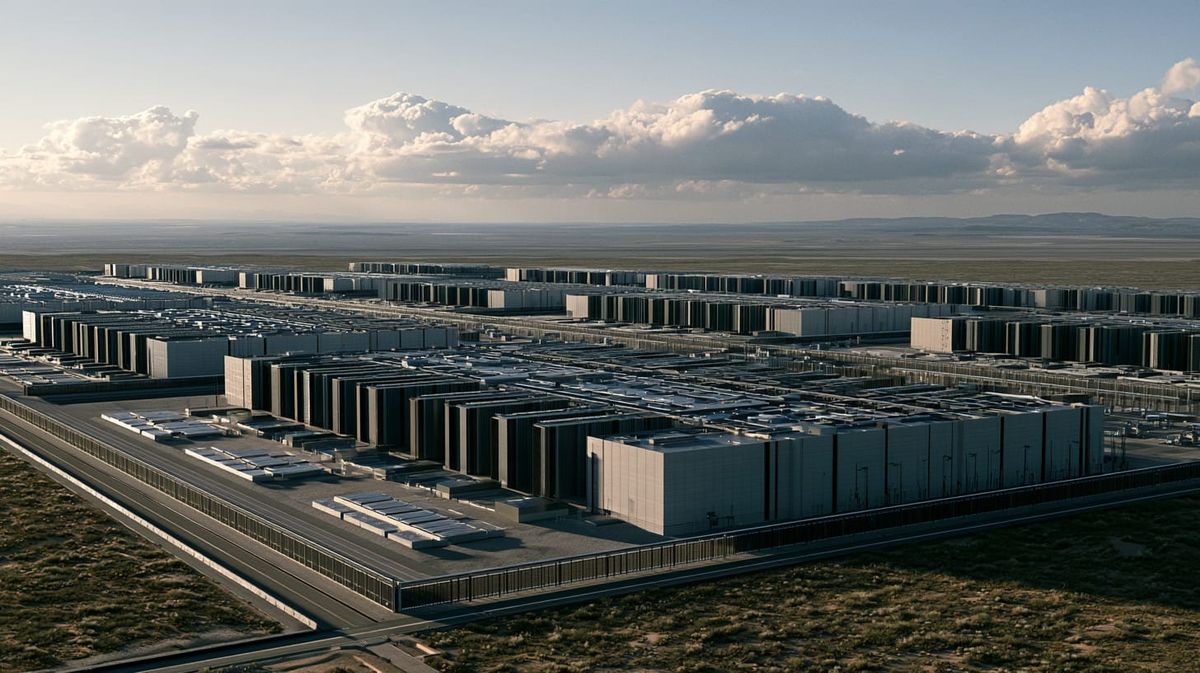
- Some new AI data-center campuses can cost $20 billion or more before all their computing equipment is installed, concentrating extraordinary amounts of property and technology in one location.
- Traditional insurers don't always have enough capacity—or affordable coverage—to insure the entire risk, prompting technology companies to retain more of it themselves.
- The trend raises a larger question for communities embracing the AI construction boom: Who ultimately bears the financial risk when something goes badly wrong?
The artificial-intelligence boom has already strained electric grids, increased demand for water and generated battles over tax incentives and utility costs.
Now it is beginning to strain something else: the insurance system.
The enormous data centers being built to train and operate increasingly powerful AI systems are becoming so valuable—and concentrating so much equipment in individual locations—that conventional insurers sometimes can't provide enough coverage for them.
As a result, technology companies and data-center developers are increasingly turning to “captive” insurance companies, essentially insurance companies that corporations create to insure themselves.
Michael Serricchio, U.S. and Canada captive solutions leader at insurance broker Marsh, predicts “explosive growth” in captives covering data-center risks, including construction, property and liability, Insurance Journal reports.
It may sound like an obscure insurance-industry development. But it illustrates just how enormous the financial bets behind the AI boom have become.
A $20 billion building — before the computers arrive
Traditional data centers were large commercial properties. The newest AI campuses are something altogether different.
Swiss Re estimates that construction costs for a single location can reach $20 billion — and the value can effectively double after expensive GPUs and other computing technology are installed.
Meanwhile, Aon says some hyperscale campuses planned over the next five years will exceed $20 billion in capital spending even before the high-value equipment is counted.
That creates an unusual insurance problem.
Instead of spreading risk among thousands of houses, cars or commercial buildings, an insurer can find itself confronting tens of billions of dollars of value concentrated on a single campus.
A major fire, tornado, hailstorm, flood, cooling-system failure or extended electrical outage could therefore generate an extraordinary loss.
And because multiple buildings on a campus may share electrical supplies, cooling systems, contractors and other infrastructure, what initially looks like an isolated failure can spread across the operation.
Some of the buildings are going up in risky places
There's another complication.
Data centers require huge amounts of land, electricity and, depending on their cooling systems, water. The places where those resources are available and relatively inexpensive aren't necessarily the places with the lowest natural-disaster risk.
Swiss Re estimates that more than one-quarter of U.S. data-center capacity may be located where three or more severe-hail days occur annually. More than 40% may be located in areas with significant to very high tornado exposure. (Swiss Re)
Drought, flooding and extreme heat add other complications.
That means the AI boom is producing enormously valuable facilities at the same time climate and weather risks are making many kinds of property more difficult and expensive to insure.
What is captive insurance?
A captive is basically a company's private insurance company.
Instead of paying an outside insurer to assume all of a particular risk, a corporation creates an insurance subsidiary, pays premiums into it and uses that pool of money to cover certain losses itself.
Traditional insurance or reinsurance can still cover catastrophic losses above a specified level.
Captives aren't new. Oil, mining and other industries with unusual or enormous risks have used them for decades.
But their use is expanding rapidly.
There are now more than 6,000 captives worldwide, writing about $240 billion in annual premiums, according to figures cited by Insurance Journal. That's nearly 20% more than two years earlier.
For large corporations, there's another attraction: money paid into their own captive doesn't necessarily disappear as an insurance expense. If losses don't occur, the corporation retains the capital and can invest it.
Some AI projects may simply be too big to insure normally
Perhaps the most striking phrase in the latest reporting comes from S&P Global Ratings.
One enormous Meta data-center project was described as “beyond fully-insurable.” In other words, the project had reached a scale at which simply buying conventional insurance against all the risks was no longer practical.
Meta ultimately used a financial structure that included guarantees supporting bondholders rather than relying entirely on conventional insurance.
Another recent example illustrates the potential gap.
A $14 billion Texas data-center project involving Meta and BlackRock reportedly obtained hundreds of millions of dollars of property, terrorism, liability and construction-delay coverage—but remained exposed to billions of dollars in potential losses beyond the insurance limits, according to Financial Times.
The project reportedly was not insured against a complete loss.
Insurers are scrambling to catch up
The insurance industry isn't walking away from the market. Quite the opposite.
Swiss Re projects global data-center insurance premiums could grow from about $10.6 billion to $24.2 billion by 2030.
And last month, Marsh launched a new insurance exchange called Stratus specifically for digital infrastructure, offering access to as much as $10 billion in property-insurance capacity for a single placement. Thirty traditional and alternative capital providers are participating.
That is an extraordinary amount of insurance capacity. The fact that the industry believes such a facility is necessary is equally extraordinary.
Why should consumers care?
Consumers aren't going to buy insurance for an AI data center. But they may nevertheless end up sharing some of its risks.
Data-center developers are negotiating with states, cities and utilities over electricity infrastructure, water supplies, tax incentives, roads and other public resources. In some areas, utilities are contemplating billions of dollars of new generation and transmission investment to serve rapidly growing data-center demand.
Insurance adds another piece to that puzzle. If a project can't be fully insured commercially, somebody still has to absorb the remaining risk.
Sometimes that's the technology company or its investors. Sometimes lenders accept part of the exposure. Sometimes elaborate guarantees or other financial structures are created.
And the important consumer-policy question is whether any of that risk eventually migrates toward utility customers, taxpayers or communities that helped make the project possible.
That isn't necessarily happening simply because a company uses captive insurance. Captives can be financially sound and are heavily used by major corporations.
But the growth of self-insurance is a useful signal: the projects have become so enormous that ordinary mechanisms for spreading commercial risk are being stretched.
The AI boom is becoming a risk-concentration experiment
AI is usually discussed as a software revolution. Increasingly, however, it is a physical infrastructure story.
AI requires power plants and transmission lines. It requires water and cooling equipment. It requires enormous buildings filled with some of the world's most valuable computer equipment.
And now it requires new ways of financing and insuring risk. That makes the growth of captive insurance more than an insurance-industry curiosity.
It's another indication that the AI infrastructure boom has entered territory where some of the economic systems surrounding it are having to invent new ways to keep up.
What this means for consumers
When a large data-center development is proposed locally, the useful questions increasingly go beyond jobs and construction spending.
Consumers and local officials may also want to ask:
- Who is paying for the new electrical infrastructure the facility requires?
- What happens to utility customers if projected data-center demand doesn't materialize?
- How much public money or tax relief is supporting the project?
- How much water will the facility consume?
- What natural-disaster risks does the site face?
- Is the project fully insured against a catastrophic loss?
- If it isn't, who bears the uninsured portion of the risk?
Those questions don't mean data centers shouldn't be built.
They mean that when projects reach tens of billions of dollars, “Who pays if something goes wrong?” becomes a consumer question, too.
--
ChatGPT provided research assistance for this story.