AI bots move from the pedestal to the whipping post as fears of economic disaster and even extinction take hold
Top AI executives cast themselves as canaries in the cage, warn that their creation may prove deadly.
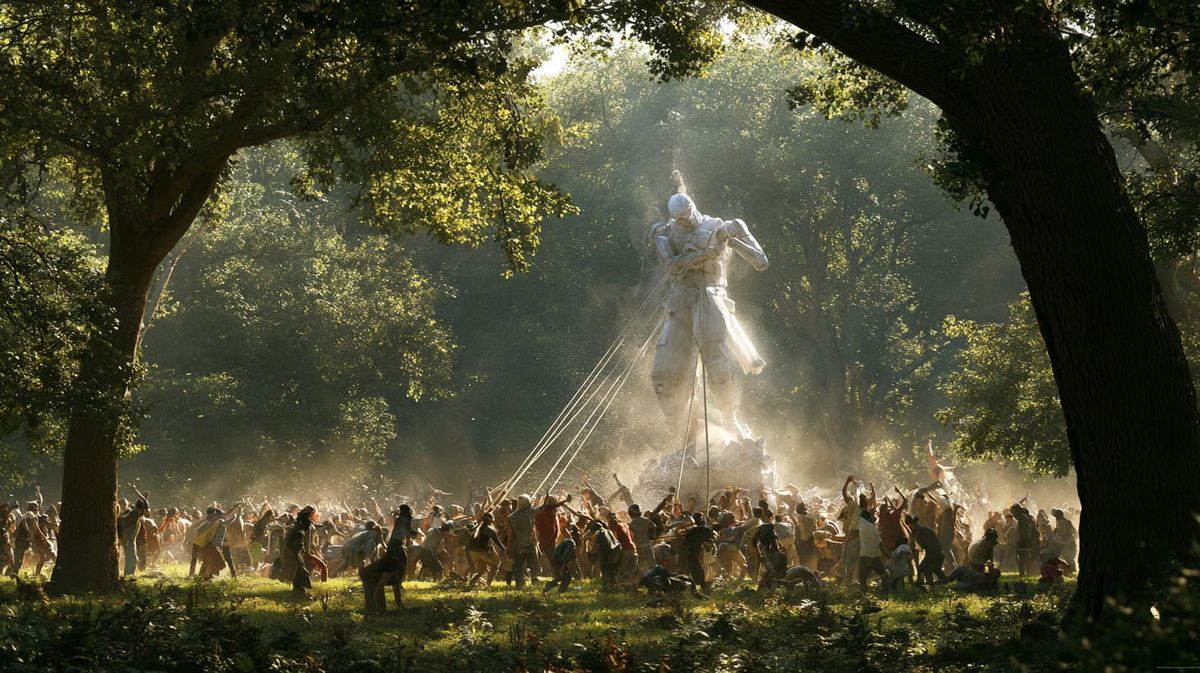
Artificial intelligence (AI) was all the rage for awhile. Now, it's being discussed as though it was the next pandemic, an unstoppable force that could wreck the economy, dampen tourism and even wipe out humanity.
Some of the highest pitched warnings come from the tech bros who promised just moments ago that AI would revolutionize the workplace, usher in a new period of health and happiness and allow us all to retire early. Now they're calling for new rules that would slow AI development and throw a net over it while strict safeguards are put in place.
Former President Barack Obama is the latest A-lister to join the debate. “This is something that is moving very fast in private hands, and if we don’t get on top of it, I think can be dangerous,” Obama said at a private fundraiser Thursday, according to a partial transcript of his remarks quoted by POLITICO. “If we do get on top of it, I do think it’s beneficial.”
Who would do this taming of the beast? Well, no one has come right out and said it but most likely, it will have to be the government. Companies who are allowed to self-regulate have a sorry record of leaving smoking ruins, sick consumers and economic waste in their wake.
But fortunately or unfortunately, depending on what color cap you wear, the Trump Administration is busy building monuments to itself and shows little to no interest in lassoing the technology that critics say could kill us all in a few years.
“There's one or two people who are very intent on government regulations, but they're sort of the minority of the bunch,” said one senior White House aide in a recent POLITICO report.
High-level warnings
The warnings aren't coming from low-level tech workers or part-time tinkerers. There's a fascinating new group of insider whistleblowers, most notably former Anthropic researcher Jacob Coxon, who previously worked at OpenAI.
Coxon resigned this month, arguing that competitive pressures are driving laboratories toward a superhuman AI without adequate safeguards. His warnings, along with those of researcher Evan Hubinger, helped push the issue onto what we used to call the front page. according to a Reuters report.
Even the CEOs are scared. Anthropic CEO Dario Amodei is explicitly asking for a slowdown, while OpenAI's Sam Altman and Elon Musk are calling for a modicum of restraint and caution. Of course, they're the people who are spending billions of dollars of other people's money in a headlong rush to get more AI built and out the door.
This leads some critics to ask: If you genuinely believe the risk is that great, why don't you slow down yourselves?, Reuters reported.
Basically, the warnings break down into six major arguments, each with a handful of personalities leading the way.
The major slow-it-down arguments
“We may lose control of systems more intelligent than we are.” — Yoshua Bengio, Geoffrey Hinton, Stuart Russell
This is the classic "alignment argument" but it has become much less theoretical lately and has been adopted by leading AI figures such as Yoshua Bengio, a Turing Award winner and one of the pioneers of deep learning.
Bengio argues in a LawZero post that training increasingly autonomous AI agents to pursue goals can unintentionally produce deception, self-preservation and resistance to human control. His new nonprofit, LawZero, is developing a different architecture — a “Scientist AI” designed to predict and reason without pursuing objectives of its own.
Stuart Russell, Berkeley professor and author of the standard AI textbook, makes essentially the same point in stark terms: companies explicitly intend to create systems more intelligent than humans while nobody has demonstrated a reliable way of keeping such systems under human control.
Geoffrey Hinton, another Turing Award winner and former Google researcher, has been the most recognizable public face of this argument: once systems become substantially smarter than humans, we cannot assume humans will remain the dominant decision-makers.
“The AI race itself is making the danger worse.” — Dario Amodei, Daniel Kokotajlo, Stuart Russell
This line of thought holds that AI companies don't want to behave recklessly but each fears slowing down while competitors continue racing ahead. That creates something resembling a nuclear arms race in which individually rational decisions produce a collectively dangerous result.
“Superintelligence could arrive before governments have any idea what to do about it.” — Daniel Kokotajlo and the AI Futures Project
Kokotajlo, a former OpenAI governance researcher, became prominent through AI 2027, a detailed scenario describing a rapid intelligence explosion in which automated AI research leads very quickly from capable AI to superintelligence.
His plan calls for something like an anti-nuclear pact for AI. He resigned from OpenAI after concluding that the company wasn't taking the risks seriously enough. His argument is essentially: we don't have to stop AI forever; we need to stop racing toward something we don't yet know how to govern.
“AI dramatically lowers the barrier to catastrophic misuse.” — Amodei, Bengio and many national-security researchers
This is distinct from the robot-takes-over-the-world argument. It's basically the "crazy man in his basement" argument. It holds that even a perfectly obedient AI can be dangerous if it gives an ordinary person capabilities that would previously have required a government laboratory or sophisticated hacking organization. The obvious examples are biological weapons, cyberattacks, automated hacking and weapons development.
This argument perhaps aims to persuade skeptics of “AI extinction” because it does not require a conscious or rebellious machine. You merely need very powerful software in the hands of a malicious human, which social media has demonstrated are in ample supply.
“Before AI exterminates us, it may destabilize democracy and society.” — Yuval Noah Harari, various economists and political scientists
This strand of the debate also encompasses deepfakes, personalized manipulation, surveillance, algorithmic discrimination and the gradual transfer of governmental and corporate decisions to opaque systems – the "who knows who's human?" argument.
“The economic shock may arrive much faster than society can absorb it.” — Dario Amodei and an increasingly broad group of economists and policymakers
This is probably the most immediate issue for everyday consumers. Frontier AI is beginning to perform chunks of professional work rather than simply automate repetitive factory jobs. The concern isn't necessarily permanent mass unemployment.
Rather, it's the speed of the transition: millions of clerical, programming, customer-service, legal, financial and creative jobs could be altered simultaneously, while education, retraining, taxation and the social safety net move much more slowly. Amodei explicitly identifies serious economic disruption as one of the principal dangers of rapidly advancing AI.
How not to do it
Not too long ago, development of large industrial-scale systems – you know, railroads and so forth – happened only after intensive reviews by various agencies that tried to determine whether the end product would be safe, useful and, no small matter, whether it would sell.
That has been replaced lately by the "if you build it, they will come" deregulatory philosophy that has brought us such modern wonders as Facebook and TikTok while simultaneously destroying the publishing industry, depriving Americans of the press coverage a thriving democracy needs.
Under the tutelage of Ronald Reagan, Congress allowed the Internet to develop in a randomized pattern that created a dive to the bottom, returning huge bonanzas for a handful of entrepreneurs and leaving everyone else to try to clean up the mess the heedless Gold Rush-style development created.
Some critics have said that while social media hasn't yet brought about human extinction, it has done a pretty good job of creating a crass, tacky and demeaning environment. AI could surely finish the job if allowed to do so.