As the CFPB retreats, a new consumer protection network is taking shape
Former federal regulators, state officials and public-interest lawyers are attempting to fill the enforcement vacuum

The federal government’s leading consumer financial watchdog may be pulling back, but many of the lawyers and regulators who built it are not leaving the field.
Instead, they are spreading out.
Former Consumer Financial Protection Bureau officials are joining state agencies, nonprofit advocacy groups and public-interest law firms, creating what some financial-industry attorneys describe as a decentralized consumer-protection “ecosystem.”
The result may not be a private version of the CFPB so much as a collection of smaller watchdogs—sometimes working together—to investigate lenders, file lawsuits and push states to adopt stronger consumer safeguards.
“Nature abhors a vacuum,” attorneys at Ballard Spahr wrote in a recent analysis of the changing enforcement landscape.
The CFPB’s retreat, they cautioned businesses, should not be mistaken for the disappearance of enforcement risk. The expertise developed inside the federal bureau is being redistributed among state regulators, attorneys general, advocacy organizations and private lawyers.
For consumers, that could mean financial companies will still face scrutiny over abusive loans, discriminatory practices, junk fees, debt collection and other misconduct.
But the protection may be more fragmented, slower and heavily dependent on where consumers live.
 The Editors
The federal watchdog has stepped back
Congress created the CFPB after the 2008 financial crisis to enforce federal consumer-finance laws and supervise banks, mortgage companies, credit-reporting agencies, payday lenders and other financial businesses.
But during 2025 and 2026, under the Trump Administration, the bureau withdrew or dismissed numerous enforcement cases, scaled back supervision and changed its regulatory priorities.
The CFPB’s own semiannual report said it dismissed or withdrew from 20 public enforcement actions that had been pending between October 2024 and December 2025.
The agency has also ended certain fair-lending investigations and supervisory work involving “disparate impact,” a legal theory used to challenge policies that have discriminatory effects even without proof of deliberate discrimination.
The CFPB still accepts consumer complaints and describes itself as supervising financial institutions for compliance with federal law. But its enforcement footprint is substantially smaller than it was under previous leadership.
That leaves an obvious question: Who steps in when a federal consumer watchdog steps back?
California is building a state-level counterweight
One answer may be California.
Gov. Gavin Newsom appointed former CFPB Director Rohit Chopra to lead the state’s new Business and Consumer Services Agency, which officially began operating July 1.
The agency brings together departments involved in financial regulation, professional licensing, consumer services and business oversight. California officials said the restructuring is intended to improve coordination and strengthen enforcement as federal consumer protections are reduced.
Chopra previously served as both CFPB director and a Federal Trade Commission member. His new position gives him authority over a broad collection of California regulators, including the state’s financial-services enforcement apparatus.
California often has an influence far beyond its borders. Its size allows the state to impose requirements that national businesses may eventually adopt across the country rather than operate under separate systems.
Still, California’s protections apply most directly to Californians. Consumers in states with less active regulators may not receive comparable assistance.
Former CFPB lawyers moving into private litigation
Another part of the emerging network is composed of lawyers who once led federal enforcement cases.
Former CFPB enforcement officials Eric Halperin, Cara Petersen and Tara Mikkilineni have launched a public-interest litigation practice to work with consumer organizations and state attorneys general.
The three lawyers helped lead CFPB enforcement efforts between 2021 and 2025 that resulted in orders requiring more than $9.5 billion in consumer payments and penalties, according to Protect Borrowers, the advocacy organization that initially hosted their strategic litigation project.
Their work builds on earlier organizations founded or staffed by former CFPB officials, including Protect Borrowers—formerly known as the Student Borrower Protection Center—and public-interest law firms that handle consumer appeals and class actions.
These groups can develop cases, recruit plaintiffs, challenge abusive practices and provide legal expertise to state officials.
They may also be willing to pursue cases that the federal government declines to bring.
Private lawyers cannot duplicate the CFPB
There are important limits.
Private attorneys cannot conduct routine supervisory examinations of financial institutions. They cannot issue the same kinds of administrative demands available to federal regulators, write nationwide rules or collect federal civil penalties.
They generally must find consumers who have standing to sue, identify a viable legal claim and overcome procedural barriers before obtaining evidence.
Many consumer contracts also contain arbitration provisions that prevent customers from joining together in court. That can make it difficult or economically impractical to bring cases involving relatively small individual losses.
State attorneys general and financial regulators possess broader powers, but their authority usually stops at state lines. Their budgets, staffing and political priorities vary widely.
A national company could therefore face aggressive enforcement in California, New York or Massachusetts while receiving relatively little scrutiny elsewhere.
That is the central weakness of the emerging system: It may preserve significant consumer-protection expertise without preserving consistent nationwide protection.
A patchwork system could leave some consumers behind
A decentralized network may be able to bring large cases, establish legal precedents and pressure companies to change their practices nationally.
It could also encourage states to experiment with stronger protections for borrowers, tenants, workers and small businesses.
But a patchwork is not the same as a federal regulator.
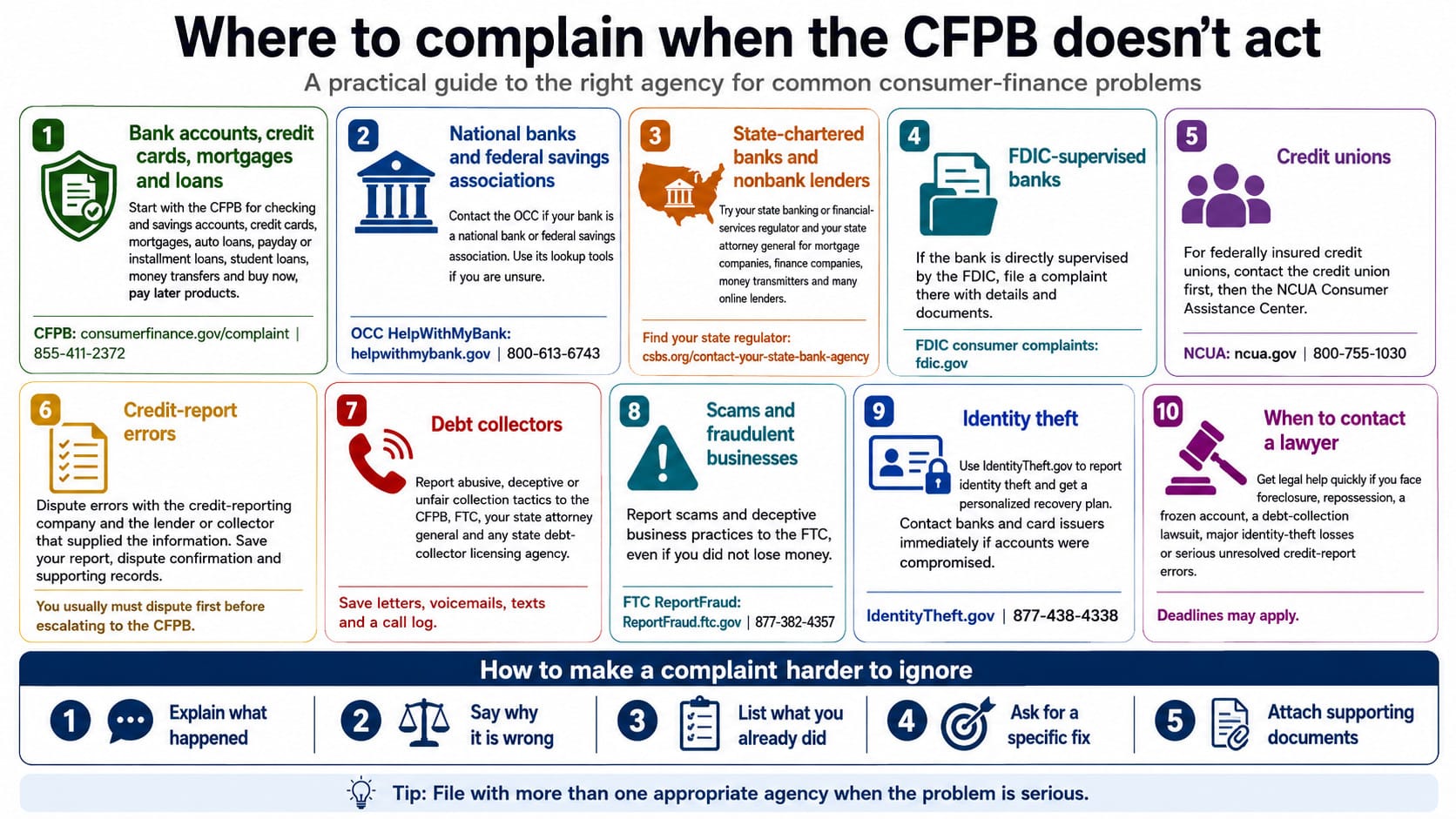
Consumers often do not know which agency regulates a financial company, whether a state law applies or where to file a complaint. Someone harmed by an online lender may have to navigate a maze of federal agencies, state regulators, attorneys general and private legal organizations.
That complexity favors well-funded companies with teams of lawyers.
It also means enforcement may become more reactive. The CFPB could identify problems during examinations before they produced a large public scandal. Private litigants typically become involved only after consumers have already suffered harm.
What consumers can do
Consumers should continue filing complaints with the CFPB, even if the agency’s enforcement priorities have changed. Complaint records can document patterns and may be shared with companies or other regulators.
Consumers should also consider contacting:
- Their state attorney general’s consumer-protection division;
- Their state banking or financial-services regulator;
- A nonprofit consumer-law organization;
- A legal-aid office or private consumer attorney; and
- The regulator responsible for a particular industry, such as mortgage lending, insurance or debt collection.
Documentation is essential. Consumers should save contracts, account statements, advertisements, screenshots, emails, text messages and records of phone conversations.
A single complaint may not produce immediate action. But repeated complaints can reveal patterns that state officials, investigative lawyers and advocacy organizations can use to build larger cases.
The bottom line
The CFPB’s reduced role does not mean banks, lenders and financial technology companies are operating without oversight.
A new network is forming from the people and institutions that once worked alongside—or inside—the federal bureau.
That network could become a formidable source of lawsuits, investigations and policy changes.
But it will not offer the uniform protection of a strong national regulator. Consumers may increasingly depend on state officials and private lawyers, creating a system in which the quality of protection varies by geography, resources and the willingness of individual organizations to take a case.
The CFPB may no longer dominate consumer financial enforcement.
Its former officials, legal theories and enforcement strategies, however, are still very much alive.