Trump Accounts launched Saturday — $1,000 to every eligible newborn
The $1,000 is intended as a starter account. It could become substantial if parents make consistent annual contributions.

A lot of babies are $1,000 richer today. The federal government launched Trump Accounts on July 4, seeding a $1,000 Treasury deposit into a tax-advantaged investment account for every eligible U.S. newborn.
Under the "One Big Beautiful Bill Act" signed a year ago, the accounts are available to children born between Jan. 1, 2025, and Dec. 31, 2028. Beginning Saturday, "parents, employers and others may contribute to the accounts," CBS said.
More than 6 million Americans have already opened one, and Michael and Susan Dell of Dell Technologies have pledged to give an additional $250 to each of up to 25 million children under 10 living in areas with median incomes below $150,000.
But, realistically, will $1,000 be a meaningful amount of money when today's babies are ready to set off for career or college?
That depends almost entirely on time, market returns, inflation and whether families add more money.
For eligible children, the program gives a one-time $1,000 federal seed contribution to children born Jan. 1, 2025 through Dec. 31, 2028, if they are U.S. citizens with valid Social Security numbers. The money goes into a child investment account, with families and others allowed to contribute up to $5,000 a year, according to the IRS.
What $1,000 could become by age 18
Assuming the money is invested and left alone:
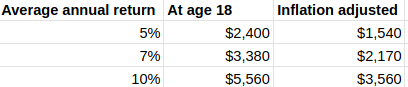
*Assumes 2.5% annual inflation.
So the headline number is meaningful but modest. Even at a solid 7% annual return, the $1,000 alone might be worth roughly $3,400 in nominal dollars, or only about $2,200 in today’s purchasing power, by the time a newborn turns 18.
The bigger value comes from follow-up contributions
The grant becomes more powerful if it turns into a regular savings habit. For example, if a family added $500 a year through age 18:
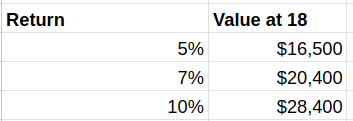
At the maximum contribution level — $5,000 a year — the account could become substantial. At a 7% average return, it could reach roughly $173,000 by age 18. But that is a benefit mostly available to families with enough spare cash to contribute consistently, which is why critics argue the program may do less for wealth inequality than advertised.
Bottom line
The $1,000 grant is best understood as a starter account, not a college plan or wealth-building solution by itself. On its own, it may cover a small slice of future education, housing or start-up costs. Its larger potential is behavioral: getting families into the habit of investing early, giving relatives or employers a place to contribute, and letting compound growth work over 18 years or more.
For consumers, the practical advice is: claim the $1,000 if eligible, but don’t mistake it for a full savings strategy. Families still may want to compare it with a 529 college savings plan, Roth IRA, custodial brokerage account or ordinary savings, depending on their goals and tax situation.
A smallish part of a bigger bill
The account launch anchors the one-year retrospective on the One Big Beautiful Bill. The law permanently preserved the top individual tax rate at 37 percent rather than allowing it to revert to 39.6 percent — a change that primarily affects individuals earning over $640,000 and married couples above $768,000. The state and local tax deduction cap was raised from $10,000 to $40,000.
Jon Whiten, an economist at the tax policy organization ITEP, said the top 1 percent are in line for $1 trillion in tax cuts over a decade. Corporations picked up permanent 100 percent bonus depreciation for short-lived assets; Amazon, Alphabet, Meta and Tesla together "took home an astonishing $51 billion in tax breaks in 2025."
Not beautiful for everyone
On the other side, CBS documented consumer losers. New SNAP work requirements captured previously exempt groups — former foster youth, veterans and people experiencing homelessness. SNAP participation dropped "by more than 4 million people, or 10 percent," through March.
Medicaid enrollees will face new work requirements and more frequent eligibility checks starting in 2027, a change projected to cut Medicaid enrollment by 5 million to 10 million.
Federal electric-vehicle tax incentives ended, and EV sales are down 22 percent so far in 2026 versus a year earlier. And roughly 34 million seniors this year claimed a new $6,000 bonus deduction available to taxpayers over age 65 — subject to income phaseouts.