Looking for a quick escape from your timeshare?
Be careful! Steer clear of anyone who promises quick, easy action

Probably nothing carries more buyer’s remorse than a timeshare. They’re usually impulse buys that, like certain other things, look a lot worse in the morning than they did the day before.
Even worse than signing up for a timeshare you can’t afford and don’t want is falling for one of the many promoters who advertise quick escapes. As a recent FTC case involving a $140 million penalty demonstrates, these schemes are mostly a way to squeeze more money out of remorseful timeshare owners.
But let’s not paint the picture as completely hopeless.
There are options—but most of them take patience and a clear-eyed approach. The key is avoiding scams while working through legitimate exit paths. Here’s a quick overview of the steps you can take:
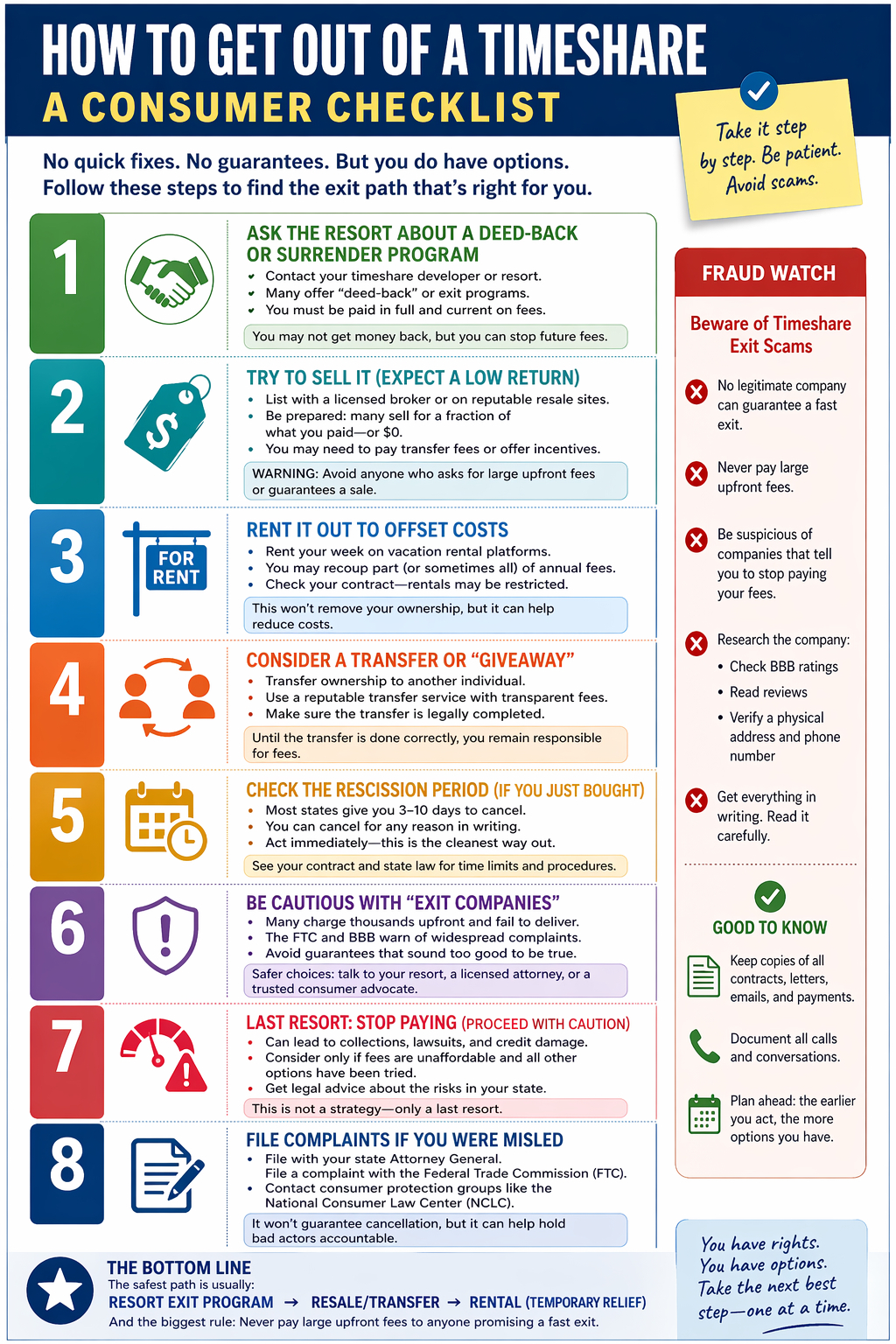
1) Ask the resort about a deed-back or surrender program
Start with the developer or resort itself.
- Many major brands (like Wyndham Destinations, Marriott Vacations Worldwide, and Hilton Grand Vacations) offer “deed-back” or “exit” programs
- You return the timeshare, and they release you from future obligations
- You usually must be paid in full and current on fees
Reality check: You won’t get money back—but you can stop the bleeding.
2) Try to sell it—but keep expectations low
You can list it on resale platforms:
- Licensed brokers
- Timeshare resale sites (often flooded with inventory)
What to expect:
- Many sell for a fraction of the original price—or $0
- You may need to offer incentives (like covering transfer fees)
Big warning: Avoid anyone asking large upfront fees to “guarantee” a sale.
3) Rent it out to offset costs
If you can’t exit immediately:
- Rent your week on platforms like vacation rental sites
- Some owners recoup part (or occasionally all) of annual fees
Limitations:
- Not all contracts allow rentals
- Competition is heavy in many destinations
4) Consider a legitimate transfer or “giveaway”
Some owners simply give the timeshare away:
- Transfer ownership to another individual
- Use reputable transfer services (with modest, transparent fees)
Important: Make sure the transfer is legally completed—otherwise you remain liable.
5) Use the rescission period (if you just bought)
If the purchase is recent, act immediately:
- Most states allow a rescission (cooling-off) period—often 3–10 days
- You can cancel for any reason in writing
Check your contract and state law. This is the cleanest way out—but it’s time-limited.
6) Be cautious with “timeshare exit companies”
This is where many consumers get burned.
- Some firms charge thousands upfront and fail to deliver
- Others use questionable or risky tactics
The Federal Trade Commission and Better Business Bureau have both warned about widespread complaints.
Safer approach:
- Look for attorneys specializing in timeshare law (if needed)
- Avoid guarantees that sound too good to be true
7) As a last resort: stop paying (with caution)
Some owners consider defaulting—but this has consequences:
- Collections activity
- Credit score damage
- Possible legal action
When it may come up:
- If fees become unaffordable and no exit options work
This is generally a last resort, not a strategy.
8) File complaints if you were misled
If the purchase involved deception:
- File with your state attorney general
- File with the Federal Trade Commission
- Contact consumer protection groups like the National Consumer Law Center
This won’t guarantee cancellation—but it can help build pressure and document abuse.
Bottom line
There’s no quick, universal escape—but the safest path usually looks like:
Resort exit program → resale/transfer → rental (temporary relief)
And the biggest rule:
Never pay large upfront fees to anyone promising a fast exit.