Inflation day arrives with gas, groceries and the housing market all in the squeeze
Inflation day arrives with gas, groceries and the housing market all in the squeeze
The first hard look at how deeply the war with Iran is leaking into the American household budget arrives Tuesday morning, when the Bureau of Labor Statistics releases April's consumer price index. Wall Street is bracing for a 3.7 percent annual inflation reading, a sharp climb from March, even as the price at the pump remains 51 percent higher than it was three months ago, the cost of canned vegetables creeps up under a 50 percent steel tariff, the spring housing market stalls and consumer sentiment hits a fresh record low. The Trump-Xi summit later this week sits over all of it.
A scan this morning of Reuters, The Associated Press, The New York Times, The Wall Street Journal, CNBC, NBC News, CBS News and Bloomberg surfaced five themes dominating consumer coverage by story volume: today's inflation reading, the renewed oil shock as cease-fire talks falter, the steel-tariff hit to grocery shelves, a spring housing bust and the deepest collapse in consumer confidence in the history of the University of Michigan index.
CPI day: 3.7 percent expected, the second post-war read
Analysts surveyed by The Wall Street Journal expect the April consumer price index to show prices rising 3.7 percent from a year earlier, a sharp acceleration from 3.3 percent in March and well above the 2.4 percent rate in February, just before the conflict with Iran began. The Journal called Tuesday's release "the second report following the conflict in Iran, which triggered a significant rise in crude oil and gasoline costs."
A 3.7 percent print would mark the highest annual inflation reading since the post-pandemic peak began rolling off in mid-2023, and it would close out the Federal Reserve's brief easing window. The Wall Street Journal's live coverage of the inflation report noted that Dow futures slipped overnight, oil rose and global stocks retreated as investors waited for the number.
The April data will also be the cleanest test yet of whether the inflation shock is broadening beyond energy. Core CPI, which strips out food and fuel, is where economists and the Fed will be looking for evidence that retailers, restaurants and service providers are passing through tariff and freight costs as well.
Oil rises again as the Iran cease-fire goes 'on life support'
Hours before the CPI release, the supply side of the inflation story tightened again. President Donald Trump told reporters Monday that the U.S. cease-fire with Iran was "on massive life support" after he dismissed Tehran's latest proposal to end the war and reopen the Strait of Hormuz, The New York Times reported. Brent crude rose more than 1 percent to top $105 a barrel and West Texas Intermediate climbed 2 percent to approach $100.
The pump is feeling it. According to AAA data cited by the Times, the national average for regular gasoline ticked down two cents Tuesday to $4.50 a gallon, but is still 51 percent above the pre-war level. Diesel, which moves nearly every consumer good in the country, held at $5.64, a 50 percent rise. The Strait of Hormuz, the Times noted, normally carries close to 20 percent of the world's seaborne crude.
California, which depends more on Middle Eastern crude than any other state, is the leading edge of the squeeze. The Wall Street Journal reported Monday that drivers paying $6 a gallon should brace for higher prices still as refinery and shipping constraints tighten.
Trump's pressure campaign has also turned to Beijing. U.S. Treasury Secretary Scott Bessent urged China to lean on Iran to reopen Hormuz, The Associated Press reported, warning that by buying Iranian oil, Beijing was "effectively funding terrorism." A trade and Iran-focused Trump-Xi summit later this week is expected to dominate market attention, the AP said, though analysts told the wire service that "few anticipate significant advancements."
Steel tariffs raise the price of canned corn and beans
A second tariff thread is now showing up on the grocery shelf. The Trump administration's 50 percent tariff on imported steel, imposed under the Section 232 national-security clause of the Trade Expansion Act, is lifting the wholesale cost of the tin-plated cans used to package fruit, vegetables, corn and beans, The New York Times reported.
The can itself accounts for roughly one-third of the wholesale cost of canned fruits and vegetables, the Times said, and tin plate is almost entirely imported. "We are required to import all this tin plate," Robert Breen, president of the Can Institute, told the Times. "There's no increase in domestic production compared to before." The paper described the steel tariffs as exceeding "many of Mr. Trump's other import duties" and noted that imports of can-grade steel skyrocketed in 2025 even as the duty climbed. U.S. Steel plans to reopen a tin-plate factory, but the Times said American can makers will continue to rely heavily on foreign supply for the foreseeable future.
The pinch lands on the most price-sensitive grocery aisle. For households that depend on shelf-stable corn, beans and tomatoes — staples for low-income shoppers and food banks alike — the steel duty is "placing a financial strain on families that depend on essential items," the Times reported.
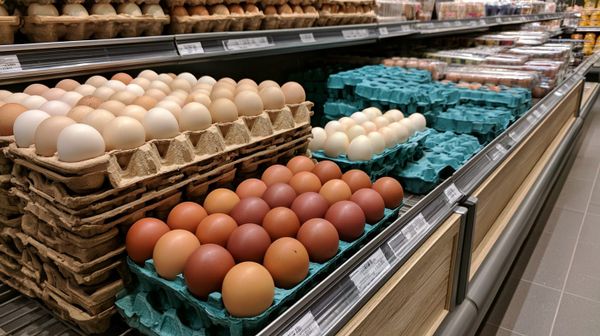
The wider basket continues to send mixed signals. NBC News' grocery price tracker showed eggs down about 30 percent from their spring 2025 peak, while orange juice was up 28 percent and ground beef up 15 percent since January 2025. Pork bacon and chicken have also risen.
Spring housing season turns into a bust
The cost of borrowing, which climbed back above 6.3 percent last week as Treasury yields rose on Iran-driven inflation fears, has now produced the bust spring that home builders feared. The Wall Street Journal reported that existing-home sales edged up just 0.2 percent in April from March to a seasonally adjusted annual rate of roughly 4.02 million, well below economist expectations.
The National Association of Realtors data, the Journal said, marked "a significant setback for a real estate sector that had anticipated a robust spring to recover from a prolonged downturn." Spring is normally the busiest stretch for home sales in the United States, accounting for roughly four in 10 transactions in a typical year.
Mortgage rates are the proximate cause. The Associated Press reported that the 30-year fixed rate climbed to 6.38 percent last week from 6.22 percent the prior week, the highest level in more than six months and a sharp reversal from a brief sub-6 percent reading earlier this spring. The 15-year rate rose to 5.75 percent from 5.54 percent. The AP attributed the move to "soaring oil prices stemming from the conflict with Iran, which has heightened concerns regarding inflation," and said the higher rates were "constraining" buyers' purchasing power by hundreds of dollars a month.
Consumer sentiment falls to a record low
The cumulative effect is now visible in how Americans feel about their own finances. The University of Michigan's preliminary consumer sentiment index for May fell to 48.2 from 49.8 in April, a fresh record low, Bloomberg reported. The survey period ran from April 21 to May 4, capturing the latest leg of the gasoline run and the renewed cease-fire breakdown.
The Wall Street Journal said the figure undershot the 49.7 reading economists had expected, and cited rising gasoline prices as the central driver of "intensified worries regarding the U.S. economy." Bloomberg said respondents cited the impact of inflation on personal finances and on buying conditions as their top concerns.
The reading is consistent with a softer spending picture. The Associated Press reported that retail sales fell 0.2 percent in January and were essentially flat in December, extending a slump that started in the back half of last year. Walmart has continued to draw shoppers across income tiers with lower prices and faster delivery, the AP said, while Target reported another decline in profits and sales as its customer base concentrates spending on essentials.
A separate consumer pressure point is taking shape in travel. CNBC reported that U.S. airlines spent 56.4 percent more on jet fuel in March than in February — $5.06 billion versus $3.23 billion, according to Department of Transportation data. Carriers have told Wall Street that customers "will begin to absorb the higher costs" through 2027. Spirit Airlines collapsed over the weekend, CNBC said, citing rising jet fuel prices as a key reason it could not exit bankruptcy on schedule.
The bigger picture
Tuesday's inflation reading is the first big number that can either ratify or push back on a story that already feels settled in the data: a war-driven oil shock layered on top of an active tariff regime is feeding through to gasoline, packaged groceries, mortgage rates and air travel all at once, and confidence is buckling. If CPI hits 3.7 percent or higher, the Federal Reserve's debate shifts from whether to cut rates back to whether it will have to raise them, with direct consequences for credit card APRs already above 21 percent and auto loan rates near 7 percent. The Trump-Xi summit, expected later this week, is the only near-term off-ramp markets have penciled in — and as the AP noted, even the people inside the talks "anticipate minimal results." For households, that means the squeeze that defined April is, for now, the squeeze that will define May.