Slate bets Americans still want a cheap, simple truck
Slate Auto says its two-seat electric pickup will start at $24,950, making it one of the lowest-priced new vehicles in the U.S.
For years, automakers have been loading new vehicles with bigger screens, more sensors, luxury trim packages and prices that have pushed many buyers out of the market.
Slate Auto is trying the opposite.
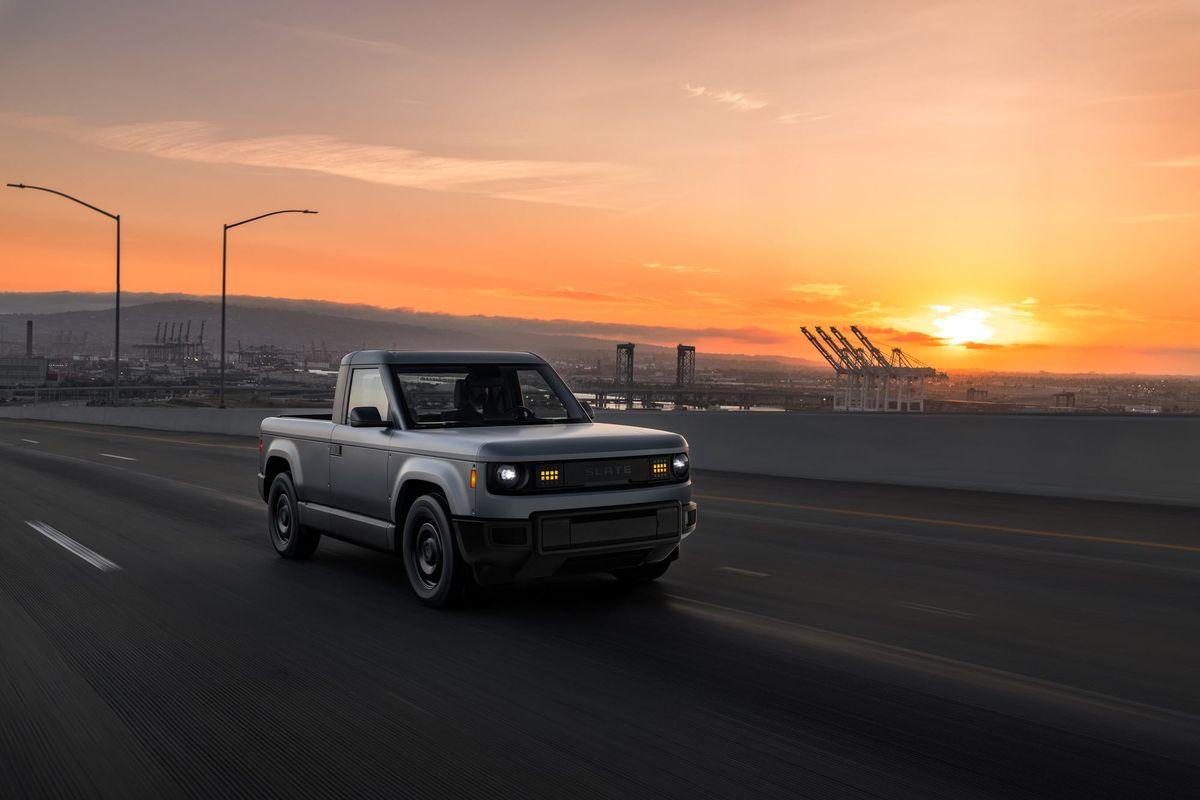
The electric-vehicle startup announced that its compact electric pickup, called the Slate Truck, will start at $24,950 before taxes, fees and options. The company says that makes it the most affordable new truck in America — and one of the few new vehicles of any kind still priced near $25,000.
The two-seat, rear-wheel-drive pickup is deliberately basic. It has an estimated 205 miles of range, a 2,000-pound towing capacity and a 1,550-pound payload rating. Slate says the vehicle will come with a 10-year, 110,000-mile battery and powertrain warranty.
The company also plans two SUV-style versions, the Squareback and Fastback, starting at $29,950. Buyers can order the vehicle as a pickup or configure it into an SUV, with more accessories and conversions available later through the company’s Slate Marketplace.
“More than 180,000 reservation holders have told us they’re ready for a vehicle that’s affordable, reliable, and built around their lives,” Slate CEO Peter Faricy said in the company’s announcement.
A low price, with a catch
The headline price is the selling point. But consumers should understand what that price does — and does not — include.
The base Slate is not a low-cost version of a high-feature truck. It is intentionally sparse. The base model skips power windows, a touchscreen and a traditional infotainment system. Controls are tactile. The idea is to make the vehicle cheaper up front and let buyers add what they want later.
That could appeal to drivers who are tired of paying for technology they do not use. It could also mean that many buyers end up spending far more than $24,950 once they add comfort, convenience or appearance upgrades.
Slate says its marketplace will include more than 200 options, with more than 80% priced under $500. Accessories are expected to include items such as stereos, roof racks, wraps, interior upgrades and SUV conversion components.
That makes Slate’s strategy part budget vehicle, part do-it-yourself platform. The company is betting that some consumers would rather buy a basic vehicle at a lower entry price and upgrade it over time than finance a more expensive model loaded with features from day one.
Why this matters
The timing is important. Cheap new cars have nearly disappeared from the U.S. market.
New-vehicle prices surged during and after the pandemic, and automakers increasingly focused on larger, higher-margin trucks, SUVs and luxury trims. Edmunds data has put the average new-vehicle transaction price near $48,000, while average financed amounts and monthly payments remain historically high.
That has left a large opening for a basic vehicle with a price closer to what new cars used to cost. But there are not many options left at that level. In recent years, sub-$25,000 vehicles have become a tiny slice of the new-car market.
Slate’s truck also arrives after the federal EV tax credit disappeared. When the company first promoted the vehicle, it suggested buyers might be able to get the effective price below $20,000 after a $7,500 federal credit. That math no longer applies, so the $24,950 base price now has to stand on its own.
The company has converted the early buzz into a sizable reservation list. Slate says it has more than 180,000 reservation holders, who paid $50 deposits. It is now moving to firm preorders, which require a $300 nonrefundable deposit, or $250 more for people who already placed a reservation.
Deliveries are expected to begin in the fourth quarter of 2026.
Direct sales may be another flashpoint
Slate plans to sell directly to consumers, avoiding the traditional dealership model. That could help control costs and simplify ordering, but direct sales remain politically and legally contentious in some states.
Tesla, Rivian and other EV makers have fought state franchise laws that restrict or complicate direct-to-consumer vehicle sales. Slate may face similar issues depending on where buyers live and how the company handles delivery, service and registration.
For consumers, that means the buying process may not look like a conventional dealership purchase. It may also make service access an important question, especially for buyers far from Slate facilities or approved repair partners.
What buyers should check before preordering
A $24,950 electric truck sounds like a breakthrough in a market where affordability has nearly vanished. But shoppers should do the same math they would with any vehicle preorder.
Before putting down a nonrefundable deposit, buyers should confirm whether the price includes destination charges, what taxes and fees will apply, whether the vehicle is eligible for any state or local incentives, and what accessories they consider essential.
They should also compare the real-world cost of the vehicle they would actually want — not just the base model. A buyer who adds a stereo, power features, racks, wraps, upgraded seating or SUV conversion parts may quickly move well beyond the advertised price.
Range is another consideration. An estimated 205 miles may be enough for commuting, local deliveries, small-business use and around-town hauling. It may be less appealing for drivers who routinely tow, drive long distances, lack home charging or live in cold-weather areas where EV range can drop.
The truck’s 2,000-pound towing rating is useful for light-duty tasks, but it is not a substitute for a full-size pickup. Consumers should match the vehicle to actual needs, not the word “truck” alone.
The bottom line
Slate is trying to prove that there is still a market for a plain, affordable vehicle in America.
If the company can deliver the truck at or near the promised price, it could give budget-conscious consumers something the market has largely stopped offering: a new vehicle without a luxury-car payment.
But the real test will come when reservation holders see the final price, choose accessories, arrange financing and decide whether a bare-bones EV is enough vehicle for their daily lives.
For shoppers squeezed by today’s auto prices, Slate’s pitch is simple: buy less car, pay less money. Whether that becomes a consumer breakthrough or just another EV startup experiment will depend on how many buyers still want simple transportation — and how close the final bill stays to $24,950.