A canceled strike, a steady shopper at Home Depot and a 30-year bond that won't come down
By Perplexity
The week's second act began with the strike that didn't happen. President Donald Trump told reporters at the White House Monday evening that he had authorized — and then postponed — a "very significant attack" on Iran that was scheduled for Tuesday, sending Brent crude down more than 2 percent and giving Home Depot's first-quarter results a slightly less ominous backdrop than they otherwise would have had. Five threads are running through the day's consumer story: an oil market that finally exhaled, a homeowner who still won't postpone the deck repair, a 30-year Treasury bond stuck near a 1999 peak, a small fleet of tankers quietly trickling back through the Strait of Hormuz, and a grocery cart whose contents have gone in five different directions since January 2025.
Trump cancels the Tuesday strike, and oil exhales
Brent crude for July delivery slid to about $109.15 a barrel Tuesday morning, down more than 2 percent, while West Texas Intermediate for June fell 1.27 percent to $107.28, after the president disclosed that he had pulled back on a planned military operation against Iran (CNBC). "We were preparing for a very significant attack tomorrow," Trump told reporters at a White House event Monday, adding, "I postponed it for a while, hopefully perhaps indefinitely, but maybe just for a short time" (CNBC). He said the leaders of Qatar, Saudi Arabia and the United Arab Emirates had asked him for more time, and that "we've had extensive discussions with Iran, and we will see what comes of them" (CNBC).
The pattern is by now familiar. The New York Times wrote that the president "has consistently issued warnings about potential strikes, only to retract those threats at the last moment," and noted that the conflict — which began with joint U.S.-Israel actions on February 28 — is now entering its third month, weeks past Trump's own initial forecast that it would last four to five weeks. White House deputy press secretary Anna Kelly said the administration's position remains that Iran must permanently renounce its nuclear aspirations (CBS News). U.S. Central Command continues to redirect 85 vessels around the blockade of Iranian ports, CBS News reported, and Treasury extended a 30-day sanctions waiver for Russian oil purchases. ING analysts cautioned that "the persistent supply disruptions mean the market has had to depend largely on inventories and alternative sources of supply, wherever feasible," and warned that flows through the Strait "could deteriorate swiftly" if talks collapse (CNBC).
Home Depot's homeowner is still spending, but the deck is on hold
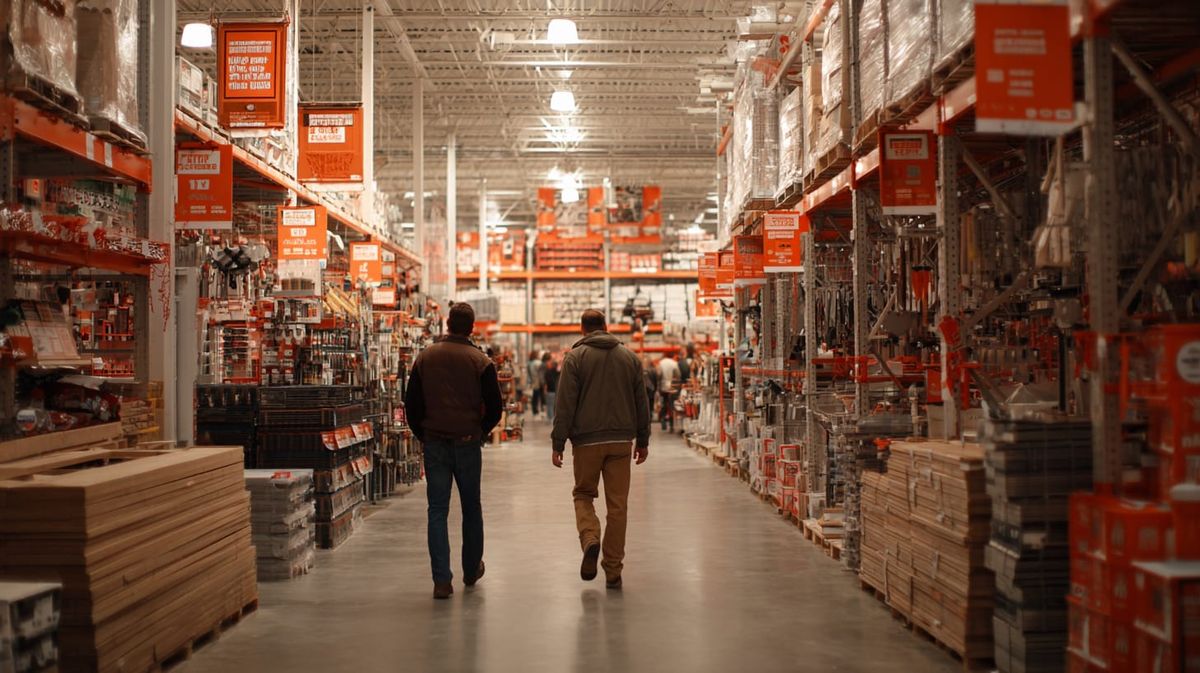
Half an hour before the opening bell Tuesday, Home Depot delivered the first major real-economy read of the week. The retailer posted fiscal first-quarter sales of $41.77 billion for the period ended May 3, up nearly 5 percent from $39.86 billion a year earlier, with adjusted earnings per share of $3.43 (CNBC).
Importantly, the company reaffirmed full-year fiscal 2026 guidance for sales growth of 2 to 4 percent and said it now expects adjusted earnings to rise by as much as 4 percent — above the 2 percent Wall Street had penciled in (CNBC).
Chief Financial Officer Richard McPhail offered the most useful sentence in the release: "The homeowner segment appears to be somewhat more financially secure than other customer groups, and we continue to observe their engagement," he said, but added that with rising geopolitical tensions and a faltering housing market, those customers are engaged "up to a certain point" (CNBC).
"They have indicated that they plan to postpone spending on larger projects," McPhail said, calling it a continuation of feedback the company has been hearing for the past few years (CNBC). The company noted that homeowner hopes for relief from a decline in mortgage rates "were dashed with conflict in the Middle East, resulting in a renewed spike in mortgage rates" (CNBC).
The pro story is where management is leaning. McPhail framed the prize as a "$700 billion pro market" that Home Depot can take a larger share of through its 2024 acquisition of SRS Distribution — a supplier to roofing, landscaping and pool professionals — plus last year's GMS deal and the SRS-led purchase last week of a wholesale HVAC distributor that serves residential and commercial customers (CNBC). The translation for a homeowner: small repairs and pro-driven fixes are holding; the new bathroom is waiting.
The bond market won't take the hint
Treasury yields backed off a sliver Tuesday morning but stayed near the multi-year peaks they set Monday. The 10-year U.S. Treasury yield slipped to 4.6073 percent — down barely more than 1 basis point — and the 30-year sat at 5.1428 percent, unchanged from a level last seen in 1999 (CNBC). The 2-year, the maturity most sensitive to the Federal Reserve, fell 2 basis points to 4.0695 percent (CNBC).
That stickiness is what matters for households. CNBC also reported that a Bank of America survey of global fund managers found 62 percent expect the 30-year yield to climb to 6 percent, while only 20 percent see it falling toward 4 percent. Jefferies chief economist strategist Kumar told the network that "even with a potential deal in the Middle East, oil prices are unlikely to revert to pre-war levels," forecasting a 25 to 30 percent increase within the next six months (CNBC). "Every government will need to provide subsidies for households regarding fuel, which translates to increased borrowing, adding pressure to the long end of the curve," Kumar said, and characterized the market's current pricing of further rate hikes as "not warranted" given the risk of inflation rising alongside slowing growth (CNBC).
The bond move is already in the mortgage paperwork. The Wall Street Journal's Bankrate-based survey put the 30-year fixed mortgage at 6.49 percent on Monday, four basis points higher than a week earlier, with the 30-year jumbo at 6.62 percent and the 30-year fixed refinance at 6.69 percent. Equity futures slipped Tuesday morning as well, with The Wall Street Journal noting that Brent has risen more than 20 percent in the past month and that traders are watching Nvidia's results Wednesday plus a coming SpaceX initial public offering prospectus. The bond market's verdict is the one that will hit the family budget first: as long as the 10-year sits near 4.60 percent and the 30-year hovers above 5.10 percent, a mortgage refinance is not coming back this spring.
A handful of brave tankers slip through the Strait of Hormuz
Beneath the macro headlines, the wartime plumbing of the global oil market is showing the first signs of working around the blockade. Bloomberg's vessel-tracking analysis found that since March 1, 19 oil- and liquefied petroleum gas-carrying ships without Iranian links have both entered and exited the Strait of Hormuz, while about 100 tankers that entered the Persian Gulf before the conflict still remain stuck for fear of attacks. "Almost all" large non-Iranian tankers that have entered the Persian Gulf during the war have managed to exit with a cargo, Bloomberg added, describing the trend as "the emergence of a small group of shipowners willing to risk crossing."
CBS News confirmed the broader picture, reporting 55 vessels crossed Hormuz last week — a modest improvement over the wartime low but still far below the typical pre-war traffic that carried roughly a fifth of the world's oil and gas. ING noted that the resumed traffic specifically included several crude tankers and an Iraqi oil shipment bound for Vietnam, but that "overall flows remain significantly below normal levels" (CNBC). For American drivers, the practical takeaway is that the marginal barrel is moving again — not enough to lower pump prices meaningfully, but enough to put a soft ceiling on the next panic spike.
The grocery cart goes in five directions
While the macro picture cools, the receipt at the checkout aisle is doing exactly what receipts do — telling whichever story the shopper most fears. NBC News' grocery price tracker, which has monitored average transaction prices since 2021, found that egg prices have fallen 30 percent since Trump took office in January 2025 — a rare bright spot driven mostly by recovery from the bird-flu shock — but that ground beef has risen 15 percent over the same window and orange juice has jumped 28 percent. Chicken and pork bacon are also higher, the tracker reported, while bread movements were not quantified in the published graphic (NBC News).
Those mixed signals come a week before the first wave of Walmart's tariff-driven price increases is expected to hit shelves nationwide, with more rolling through June. The arc lines up neatly with Home Depot's lived-by-the-CFO description of a homeowner who is willing to spend on repair but unwilling to commit to discretionary upgrades. As The Wall Street Journal's livecoverage of the market noted, equity investors are also keeping an eye on the early shopper read, with Nvidia's results due Wednesday and Memorial Day weekend looming as the unofficial start of the U.S. summer season. NBC News' shopping team advised buyers that seasonal home and outdoor goods, including grills, pizza ovens and Adirondack furniture, will see the deepest cuts of the year — Wayfair, for instance, was offering a foldable outdoor chair at $98.99, down from $269, a 63 percent discount.
The bigger picture
Five separate stories on Tuesday, five very different speeds. The president walks back a strike at 6 p.m. Eastern and oil reprices in time for the European open. Home Depot's homeowner walks into the store at 9 a.m. and still tells the cashier the deck rebuild is going to wait. Bond traders look at the 30-year and price in another decade of pricier money. A handful of supertanker captains decide the war risk is worth a paycheck. And five aisles inside a Walmart, the egg case has cheap eggs while the meat case has expensive beef. What ties them together is not a single shock but a single hesitation — American consumers, businesses and lenders are all watching the same Persian Gulf coastline, ready to move when it does, and pausing on big decisions while it doesn't.
If Wednesday's Nvidia call lands well and Tehran returns to the table with something more credible than a delay, that pause could shorten. If not, Memorial Day will be the first full holiday the country celebrates with a 5 percent 30-year Treasury, a $4.50 gallon of gas and a homeowner still saying maybe next year.