Inflation breaks 3.8 percent as Trump heads to Beijing with a gas tax idea in his pocket
The April consumer price index landed Tuesday morning at 3.8 percent, the hottest annual inflation reading since May 2023, and consumers spent the rest of the day watching the dominoes fall.
The April consumer price index landed Tuesday morning at 3.8 percent, the hottest annual inflation reading since May 2023, and consumers spent the rest of the day watching the dominoes fall. Grocery prices posted their sharpest monthly jump in nearly four years. President Donald Trump boarded Air Force One bound for Beijing for a summit that will be defined by the Iran war he can't end. He floated a suspension of the federal gas tax to take the edge off a price spike that has now run for 11 weeks. And a separate New York Times analysis showed the blue-collar trades — the workforce Trump promised would boom — are quietly shedding jobs at a rate not seen since the 2009 recession.
A scan this morning of Reuters, The Associated Press, The New York Times, The Wall Street Journal, CNBC, NBC News, CBS News and Bloomberg surfaced five themes dominating consumer coverage by story volume: the CPI surprise, the grocery aisle's worst month since 2022, the opening of the Trump-Xi summit, the politically charged gas tax proposal and a fraying labor market beneath the headline jobs numbers.
CPI hits 3.8 percent and shuts the door on Fed cuts
April's consumer price index rose 0.6 percent on the month and 3.8 percent from a year earlier, CNBC reported, citing the Bureau of Labor Statistics. The annual reading was 0.1 percentage point above the Dow Jones consensus, half a percentage point above March's 3.3 percent, and the highest since May 2023.
Energy was the main driver. Energy prices rose 3.8 percent in April alone and 17.9 percent over the past year, contributing more than 40 percent of the overall monthly increase, according to CNBC. Gasoline prices were up 28.4 percent from a year earlier. Shelter rose 0.6 percent on the month after a stretch of moderation; apparel and household goods, both sensitive to tariffs, each rose 0.6 to 0.7 percent. Airfare jumped 2.8 percent on the month and is now up 20.7 percent over 12 months.
Real wages went the other way. Workers' average hourly earnings, after inflation, fell 0.5 percent on the month and are down 0.3 percent over the year, CNBC said.
"Inflation is currently the primary challenge facing the U.S. economy," Robert Long, an economist at Federal Credit, told CNBC. "For the first time in three years, wage gains are being consumed by inflation, posing a setback for middle-class and lower-income families, who are acutely aware of this reality."
The Federal Reserve's path narrowed sharply. Traders raised the probability of a rate increase by year-end to roughly 30 percent. "Considering that inflation is trending in the wrong direction and the labor market remains stable, it is improbable that the Fed will reduce interest rates in the near future," Chris Zaccarelli, chief investment officer at Northlight Asset Management, told CNBC. "In fact, we may begin to factor in rate increases for the upcoming year."
Bloomberg and The Wall Street Journal's live coverage said 10-year Treasury yields rose to 4.462 percent, a one-year high, after the print. The S&P 500 pared earlier losses; Dow futures opened lower Wednesday.
Groceries post the worst month since 2022
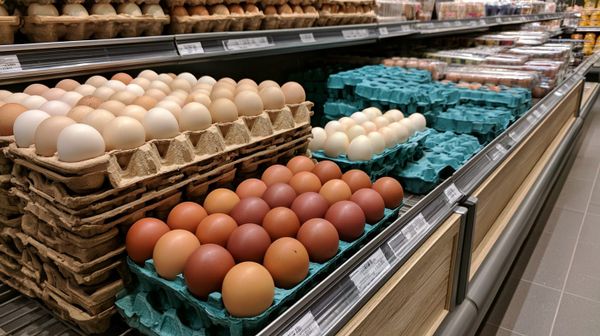
Inside the CPI, the grocery aisle was the story that hit households hardest. Food-at-home prices rose 0.7 percent in April, the biggest monthly jump since August 2022, The Associated Press reported. Year over year, food at home was up 2.9 percent and overall food prices climbed 3.2 percent — above the 2.6 percent 20-year average tracked by the U.S. Department of Agriculture.
The leaders were the staples shoppers see most often. Meat prices rose 8.8 percent from a year earlier, beef was up 15 percent, fresh fruits and vegetables 6.5 percent, nonalcoholic beverages 5 percent and coffee 18.5 percent, the AP said. Tomatoes imported from Mexico — hit by a 17 percent duty the Trump administration imposed last year — were up 40 percent at retail in the 12 months before April. Butter, by contrast, was 5.8 percent cheaper and egg prices were down 39 percent as farmers rebuilt flocks decimated by bird flu.
"The full impact of rising energy costs on food likely has not hit retail grocery prices yet," Ken Foster, a professor of agricultural economics at Purdue, told the AP, noting that higher costs to produce, process, store and transport food typically take three to six months to show up on shelves. Most of April's increase, Foster said, "probably predates the conflict" with Iran. The next two reports, he warned, will start to capture it.
Raymond Campise, who owns Sparrow Market in Ann Arbor, Michigan, told the AP that vendors have begun tacking fuel surcharges onto deliveries in recent weeks and that wholesale prices for meat, produce and several other categories have moved up. The AP noted that diesel powers the boats, tractors and trucks that ship 83 percent of U.S. agricultural products, and that roughly 30 percent of the world's fertilizer normally moves through the Strait of Hormuz.
That broader basket builds on a packaging story the same Times reported a day earlier: a 50 percent tariff on imported steel is pushing up the wholesale cost of tin-plated cans that hold corn, beans and tomatoes, The New York Times said, with the can itself representing roughly one-third of wholesale cost.
Trump arrives in Beijing for a summit "of reduced ambitions"
Trump arrives in Beijing on Wednesday for a long-delayed summit with Xi Jinping that he had hoped would be a victory lap. Instead, The New York Times reported, he is landing six weeks behind his original timetable, with Iran's nuclear stockpile "precisely where it was, still buried beneath the debris of an American airstrike from last June" and the Strait of Hormuz still blocked.
The Times described the agenda as one "of reduced ambitions," shadowed by the war and centered on whether the two presidents can keep the U.S.-China relationship from deteriorating further. The Strait, the paper noted, carries "over 30 percent of China's oil and slightly less of its natural gas." Trump is traveling with a contingent of corporate executives that includes Elon Musk of Tesla and SpaceX, soon-to-retire Apple CEO Tim Cook and top executives from Goldman Sachs.
For consumers, the trade backdrop matters most. The Associated Press summit primer recounted that the U.S.-China trade war "intensified in April of last year during what Trump dubbed 'Liberation Day,'" when he imposed 34 percent tariffs on all Chinese imports. The two sides extended a fragile trade truce in South Korea in October. "It is possible for both sides to announce a comprehensive trade deal this time around," Zhao Minghao, a professor at Fudan University, told the AP. "However, this does not signify the end of the trade war."
The summit also collides with last week's federal court ruling that struck down a major piece of Trump's tariff regime, The Associated Press reported separately. The administration is appealing, but the ruling left companies and retailers without a settled picture of which duties will stand.
A gas tax holiday — if Congress will allow it
To counter the political damage of the price surge at home, Trump proposed Monday to suspend the federal excise tax on gasoline and diesel until prices fall, The New York Times reported. The tax is roughly 18 cents a gallon on gasoline and 24 cents on diesel.
"I think it's a great idea," Trump told reporters. "We're to take the gas — a period of time — when gas is down, we'll let it phase back in." The Times noted the savings would amount to "a small percentage" of a $4.50 gallon, and the proposal would require congressional approval; the White House has not said whether it plans to push the bill. In 2022, the Times reminded readers, a similar Biden proposal "ultimately did not materialize," with Republicans calling it "a gimmick and poor policy."
Reaction in Trump's own party was uneven. Representative Marjorie Taylor Greene, the Times reported, posted on X, "please do the peasants more bread." Senator Mark Kelly, an Arizona Democrat who first proposed the idea in March, said: "Families need help now."
Energy Secretary Chris Wright said on NBC's "Meet the Press" that "all measures that can be taken to lower the price at the pump" had the administration's support. The Times reported that gas prices have risen roughly 50 percent since the conflict began, with no firm timeline for relief.
The labor market beneath the headline
The labor market has been the one cushion under the consumer this spring. But a New York Times analysis found the blue-collar trades — manufacturing and construction — have lost roughly 150,000 jobs annually as of March, with hiring in manufacturing down about 40 percent from its 2022 peak. "There are jobs available," economist Joseph Brusuelas of RSM told the Times, "but at this moment, the demand for blue-collar labor is insufficient to meet the supply."
The contrast with the broader jobs picture is sharp. CNBC reported that the April employment report came in well above expectations, with retailers adding nearly 22,000 jobs and the unemployment rate holding at 4.3 percent. But underemployment has been climbing, and rising interest rates — pushed back up by the Iran shock — have stalled the housing construction that normally sustains the trades.
Health care and social assistance, occupations dominated by women, have driven nearly all the net job growth in 2025 and 2026, the Times said. Employment growth for women this year is running nearly three times that of men.
The bigger picture
For consumers, Tuesday's CPI changed the question. With inflation at 3.8 percent and energy still climbing, the Federal Reserve is now expected to hold rates — and possibly raise them — through year-end. That keeps mortgage rates above 6.3 percent, auto loan rates near 7 percent and credit card APRs above 21 percent at exactly the moment grocery, fuel and airfare bills are rising the fastest. The Trump-Xi summit and the gas tax holiday are the two near-term political off-ramps, but neither, on its own, will move the math on April's number. As Sam McCann, senior economist at Edward Jones, told CNBC, "the economy appears to be weathering this price shock effectively so far" thanks to refunds, hiring and corporate profits — but "there are limits to these buffers." May's report, on June 11, will start to show where those limits are.